

Rent due on the first. A maintenance request on the second. A lease renewal you meant to handle last week. If you’re managing rentals, you know the drill. You patch things together with spreadsheets, bank statements, and a long email thread you swear you’ll organize later. Part of you thinks this is just how it goes, so you roll with it. You make it work. Still, it eats up your evenings and chips away at your focus.
At some point, you’ll start to wonder if there’s a simpler way to keep rent collection, tenant screening, leases, and maintenance in one place without juggling five different apps. That’s where property management software comes in. It gives you a clear system that helps you stay organized. It’s easier to grow at your own pace. And when everything lives on one platform like TenantCloud, it starts feeling more manageable.
What Is Property Management Software?
Property management tends to start on a small scale. One rental. One tenant. One lease saved somewhere on your laptop. You tell yourself you’ll keep track of everything in a spreadsheet and your regular accounting software. And for a while, that works perfectly fine. But then rent payments overlap, maintenance requests stack up, and you’re digging through emails trying to confirm who signed what and when.
We’ve all been there before. Managing rental properties can feel like spinning plates. Property owners, property managers, and real estate professionals all face the same thing: too many moving parts and not enough time.
So, what is property management software?
In plain terms, it’s a single platform that helps you run your rental business without swapping between five different tools. Instead of using spreadsheets for rent collection, separate accounting software for finances, and sticky notes for lease dates, property management software brings everything into one place.
Modern property management software grew out of frustration. The spreadsheets were messy. General accounting software wasn’t built for rental properties. As such, property management software solutions were created to simplify daily work and cut down on manual tasks that drain your time.
With the right system, you can handle online rent collection, lease management, tenant screening, accounting features, and maintenance management from one dashboard. You spend less time reacting and more time growing your portfolio.
 What Is Property Management Software and How Does It Work?
When people ask, what is property management software, they’re really asking, “How do I stop chasing rent, paperwork, and repair updates all day?”.
Property management software is a digital system built specifically for managing rental properties from start to finish. You log into one centralized dashboard. From there, you can see everything about your properties. Tenants. Rent payments. Lease agreements. Maintenance tasks. Even financial reports. Everything lives in one place. No bouncing between tabs. No guessing where that file went.
Automation does a lot of the heavy lifting. Rent reminders can go out automatically. Tenants can pay online. Payment history updates in real time. Lease dates are tracked so you’re not surprised by an expiration. Instead of manually updating spreadsheets, the system keeps your property data organized as you go.
Online portals play a big role too. A tenant portal allows renters to submit maintenance requests, pay rent online, and review their lease agreements. On your side, you can track those maintenance requests, respond quickly, and keep communication clear. Property managers, property owners, and tenants stay connected without endless email threads.
All of this changes your day-to-day routine and puts you in more control. That’s why property management software makes all the difference. It gives you a smoother way to run your rental business without you feeling buried under it.
Who Uses Property Management Software?
You might think property management software is only for big companies with huge portfolios. But it’s not.
- Property managers and property management companies use it to stay on top of leases, maintenance, and owner reports without drowning in admin work.
- Real estate investors rely on it to track performance across properties and keep a close eye on cash flow.
- Real estate professionals use it to stay organized and responsive.
- Landlords with residential properties and residential units lean on it too.
- Even small rental business owners with just a few units benefit from having everything in one place.
- Some community associations and homeowners associations even use it to manage communication, payments, and shared responsibilities.
The needs vary. An investment property owner cares deeply about reporting and returns. Someone managing multiple properties needs automation and visibility across the board. A single-property landlord may just want easier rent collection and lease tracking.
Some managers try to juggle multiple tools. One for accounting, another for screening, another for maintenance. Others prefer an all-in-one system that keeps everything connected. In the end, it’s about wanting a smoother way to manage properties.
Key Features of Modern Property Management Software
At first, you just want something that helps you keep track of rent. Then you realize rent is only one piece of the puzzle. Leases expire. Maintenance pops up at the worst time. Owners want reports. Tenants want answers. That’s where the key features of modern property management software start to matter.
The best platforms bring core features together so managing properties feels less scattered and more controlled. Here’s what that looks like.
Tenant management
Tenant management keeps all your renter details in one place. Contact info. Lease terms. Payment history. Notes from past conversations. Instead of digging through emails, you can see the full picture instantly.
Lease management
Lease management tools help you create, track, and update lease agreements without chasing paperwork. It keeps everything organized across multiple units.
Maintenance management
Maintenance management lets tenants submit requests online and allows you to assign, track, and close tasks without confusion. No more “Did you call the plumber?” texts floating around.
Online rent collection
Online rent collection gives tenants the ability to pay digitally. You can collect rent online, send reminders, and track rent payments in real time.
Accounting features
Built-in accounting features help you track income, expenses, and generate reports without exporting everything into separate accounting software.
Document storage
Document storage keeps leases, inspection reports, invoices, and rental agreements in one secure location. No more hunting through folders.
Online portals
Online portals connect everyone. Tenants can pay rent, submit maintenance requests, and view documents. Owners can access owner statements and performance updates.
Rental listing syndication
Rental listing syndication allows you to post vacancies across multiple platforms from one dashboard, helping you reach prospective tenants faster.
Property inspections
Property inspections can be logged and tracked digitally, keeping records organized and easy to review later
Owner statements
An owner statement is generated automatically. This means property owners can see income, expenses, and property performance without waiting on manual updates.
All of these comprehensive features work together to streamline property management operations. Instead of piecing together multiple tools, modern property management software gives you one connected system that’s easy to monitor and use.
Online Rent Collection and Online Payments
Chasing rent is exhausting. You send a reminder. You wait. You check your bank account. You send another message. It’s awkward for tenants and frustrating for you. Online rent collection changes that.
When you collect rent online, tenants can make online payments through a secure portal using ACH transfers, debit, or credit cards. Some even set up automatic rent payments, so the money moves on its own each month. No awkward follow-ups. Just automated reminders being sent out before the due date reminding tenants their rent is due. If rent hasn’t come in, the system nudges the tenant for you.
You also get a clean and organized payment history. Every transaction is logged, showing who paid, when they paid, and how much. That makes bookkeeping easier and removes guesswork during tax season.
For tenants, online payments are convenient. They don’t have to drop off checks or worry about mailing delays. For property managers and property owners, rent collection becomes a lot more predictable. There’s also the security factor. Digital systems encrypt transactions and store payment data safely, which is far safer than handling paper checks or cash.
Once online rent collection is in place, the monthly scramble completely goes away. Rent comes in. Records update automatically. And your focus moves away from chasing payments to growing your rental business.
Lease Management and Rental Agreements
Leases have a way of sneaking up on you. One expires. Another needs updating. A tenant asks for a copy and you’re not quite sure where you saved it. It’s manageable with one unit, but it gets messy with several. Lease management tools simplify that by allowing you to create digital lease agreements using templates, customize rental agreements for each property, and send them for e-signatures.
Expiration dates are tracked automatically too. Instead of being surprised by a lease ending, you see it coming weeks in advance. That gives you time to plan renewals or prepare for a vacancy. Automated renewal reminders can prompt both you and the tenant. It keeps communication proactive instead of rushed at the last minute.
Every signed lease agreement is stored in document storage, organized by property and tenant. If someone asks for a copy, it takes seconds to find. For landlords managing multiple rental properties, keeping track of several lease agreements at once can feel overwhelming. But with digital lease management, you see them all in one dashboard. Start dates. End dates. Terms. Status. Everything that you need to know.
Once your leases are organized and searchable, you stop worrying so much about paperwork. You know where everything is, and that kind of visibility changes how you manage your rentals.
Tenant Screening and Tenant Management Tools
Instead of collecting paper forms or juggling attachments, tenant screening and solid tenant management tools allow you to accept rental applications online. Prospective tenants fill out their information directly through your platform. Everything stays organized in one place.
From there, you can screen tenants using built-in background and credit checks. Rental history, income verification, and screening reports help you see the full picture before handing over the keys. Being thorough helps you make better decisions so that your rental properties remain stable and profitable.
And once someone moves in, tenant management doesn’t just go away. A tenant portal gives renters a clear place to view their lease, check payment history, and communicate with you. Tenant interactions stay professional and are no longer scattered between texts and emails.
The result is fewer misunderstandings, fewer surprises, and better tenants over time. So when you combine online applications, proper tenant screening, and organized communication tools, you’ll feel like you’re building a rental business with confidence.
Maintenance Management and Handling Maintenance Requests
Maintenance is one of those things you can’t ignore. A leaking pipe. A broken heater. Maintenance management brings some order to that chaos.
Through a tenant portal, renters can submit maintenance requests directly inside the platform. Instead of calling or texting, they describe the issue, upload photos, and send maintenance requests. You see the request instantly and can prioritize it.
From there, you handle maintenance requests using workflow tracking. Assign the job. Set a status. Mark it complete when it’s done. You can see open and closed maintenance tasks at a glance, which keeps nothing from slipping through the cracks.
Vendor coordination becomes easier too. You can track who handled the repair, log costs, and keep records for future reference. Over time, this creates a clear history of property maintenance for each unit.
Scheduling a rental property inspection fits naturally into this system as well. Inspection notes, follow-ups, and repairs all live in one place. That makes long-term property maintenance planning more realistic and less reactive.
Accounting Features and Financial Reports
Numbers can be the most stressful part about managing property. Property management fees need to be tracked accurately along with everything else. Before long, you’re staring at a spreadsheet wondering if you missed something. That’s when the panic settles in.
A lot of landlords start with general accounting software. It works fine for basic bookkeeping. But rental properties have their own rhythm. Security deposits. Late fees. Owner distributions. A general system wasn’t built with those details in mind.
Modern property management platforms include accounting software designed specifically for rentals. You can track income and expenses for each unit. Every online rent payment updates automatically. Maintenance costs get logged under the correct property without having to bounce between systems.
Generating financial reports becomes simple instead of intimidating. Need a profit and loss statement? It’s there with a couple of clicks. Want a snapshot of how each unit is performing? Done. A rent roll report can show you who’s paying, who’s late, and how your portfolio looks at a glance.
Owner statements are another big one. If you manage properties for someone else, you know the monthly “How did we do?” question. Instead of building reports by hand, owner statements can be created automatically and shared in minutes. That keeps communication smooth and professional.
Tax season feels easier too. When income and expenses are tracked consistently all year, you’re not scrambling in April. The records are already organized. You can export reports, share them with your accountant, and move on with your day.
Best Property Management Software: What to Look For
Once you decide that you need a system, the next question is usually something along the lines of “What’s the best property management software?”
Luckily for you, there’s no shortage of property management software options. Every platform promises to save you time. Every site lists pages of features. So it’s easy to get stuck comparing charts instead of making a decision.
The key is to just start simple. The right property management software should feel easy to use from day one. A user-friendly interface matters more than flashy graphics. If you need to refer to a huge manual just to collect your monthly rent, then it’s probably not the right software for you
Take a look at the comprehensive features. Does it cover rent collection, lease tracking, maintenance, accounting, and reporting in one place? Or will you still need separate tools to get those features?
Pricing matters too. Some platforms charge a flat monthly fee. Others charge per unit. Think about where your rental business is heading. If you plan to grow, make sure the cost structure won’t punish you for adding more properties. Scalability is key. The best property management software grows with you. One property. Ten. Fifty. You shouldn’t have to switch systems every time your portfolio expands
Consider integrations and third party apps as well. Can it connect with tools like QuickBooks or listing platforms? Data migration is another factor to consider. Moving from spreadsheets or another system should feel like an option for you. It shouldn’t feel like you have to start from scratch.
At the end of the day, the right property management software makes your daily routine easier. It reduces friction with day-to-day tasks. It keeps information organized. It gives you a clearer view of your business. When you find the right platform that handles all of the details without adding more complexity, your day becomes a whole lot smoother.
Free Property Management Software: Is It Worth It?
When researching property management software, “free” is hard to ignore. If you’re managing one unit — or just testing the waters as a new landlord — avoiding a monthly fee can feel like the smart move.
And sometimes, it is.
Free property management software can be a practical starting point for small portfolios. Many free tools offer basic functionality that helps you stay organized without adding overhead.
What Free Software Typically Includes
Depending on the provider, you may get:
- Basic rent tracking
- Simple document storage
- Limited accounting tools
- A basic tenant portal
- Access to one or two properties
For landlords with minimal complexity, that may be enough — at least temporarily.
Where Free Tools Start to Fall Short
The limitations usually appear as your rental business grows.
Free platforms often include:
- Caps on properties or tenants
- Limited financial reporting
- Basic or restricted accounting features
- Add-on fees for online payments
- Charges for tenant screening
- Transaction fees that accumulate over time
What initially feels cost-effective can quickly become restrictive — especially if critical tools are locked behind upgrades or paywalls.
There’s also a scalability issue. If your software can’t grow with your portfolio, you may eventually face a disruptive migration to a new system.
Property Management Software for Investment Property Owners
Owning an investment property shifts your mindset. You’re no longer just collecting rent — you’re evaluating performance, protecting margins, and planning for long-term growth. Real estate investors need more than organized records. They need visibility, control, and data that supports strategic decisions.
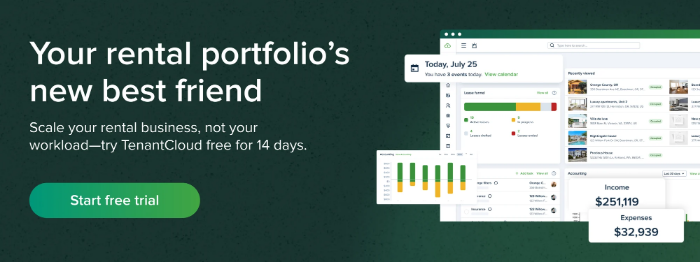
When rentals are part of an investment portfolio, software should function as a performance dashboard — not just a payment tracker.
What Investors Actually Need
A strong property management platform helps investment property owners:
- Track portfolio performance in one place
- View income, expenses, occupancy, and property-level performance without piecing together multiple accounts or spreadsheets.
- Monitor ROI with real data
- Access reporting tools that highlight trends over time, including rent growth, expense increases, vacancy rates, and net operating income.
- See cash flow instantly
- Track which units are paid, which are late, and what your total monthly revenue looks like — without manual calculations.
- Evaluate expense patterns
- Identify rising maintenance costs, vendor trends, and operational inefficiencies before they eat into profits.
- Scale without operational breakdowns
- Add properties without needing new systems, more spreadsheets, or complex workarounds.
As your portfolio grows, what once felt manageable can quickly become chaotic. What works for one property often collapses at five. Software built for managing properties at scale ensures that growth doesn’t create confusion.
Turning Rentals Into Real Assets
Property management software doesn’t replace a smart investment strategy — it strengthens it.
When your financials are clear, your reports are accessible, and your operations are organized:
- You stop reacting to problems.
- You start making proactive decisions.
- You move from guesswork to measurable performance.
At that point, your rental properties stop feeling like a juggling act — and start operating like the business assets they were meant to be.
Why Property Management Software Makes All the Difference
So, what is property management software really?You don’t have to keep piecing your rental business together with spreadsheets and separate apps. TenantCloud gives you one place to list properties, screen tenants, collect rent, manage maintenance, and track your numbers without the chaos.
From online rent collection and built-in property management accounting to listing syndication and tenant screening with detailed reports, everything works together in a way that saves time and keeps you organized. Landlords report saving up to 20 hours a week compared to doing it all manually.From online rent collection and built-in property management accounting to listing syndication and tenant screening with detailed reports, everything works together in a way that saves time and keeps you organized. Landlords report saving up to 20 hours a week compared to doing it all manually.
FAQs
What is property management software?
Property management software is a digital platform designed specifically to help landlords and property managers oversee rental operations. Unlike general accounting tools, it combines financial tracking with operational tools such as rent collection, lease management, maintenance coordination, tenant screening, and owner reporting.
Instead of juggling spreadsheets, email threads, and separate accounting programs, property management software centralizes everything into one system. It’s built to handle the day-to-day realities of rental properties — not just the numbers.
How does property management software work?
Property management software operates through a centralized online dashboard. After setting up your properties and tenants, you can track lease terms, rent payments, expenses, maintenance requests, and communications in one place.
Most platforms connect directly to bank accounts for automated rent processing and reconciliation. Tenants can log into their own portal to pay rent, submit maintenance requests, and access lease documents. Owners may also have access to financial reports and performance data. Automation handles rent reminders, late fees, recurring charges, and reporting — reducing manual tasks and minimizing errors.
In short, it organizes both the operational and financial sides of rental management into one streamlined workflow.
Who should use property management software?
Property management software is useful for anyone managing rental properties — whether that’s a landlord with a single unit or a company overseeing hundreds of doors.
It’s especially valuable for:
- Landlords who want automated rent collection
- Property managers working with multiple owners
- Real estate investors tracking performance across properties
- Growing portfolios that need scalable systems
- Community associations managing dues and maintenance
Can property management software grow with my portfolio?
Yes. The right platform supports you with one property or many. As you add units, you keep the same system, reports, and workflows without starting over.


