

Owning a rental property sounds straightforward – until you're personally fielding a maintenance call at 11pm, chasing a late rent payment, or trying to figure out whether a lease clause complies with a recently updated local ordinance.
At that point, leaving things to a professional sounds more appealing.
Understanding what a property management company does is the first step toward deciding whether hiring one is the right move for your properties. For some landlords, it makes the most sense. For others, the smarter path is managing the property themselves with better tools.
This guide will help you figure out which side of that line you're on.
TL;DR
A property management company handles the day-to-day operations of a rental property on behalf of the owner: finding and screening tenants, collecting rent, coordinating maintenance, managing leases, and ensuring legal compliance.
It's a valuable service, but the monthly fees may mean it’s not the right fit for every situation. This guide covers what property managers actually do, when hiring one makes sense, and how software like TenantCloud offers self-managing landlords the same professional resources at a fraction of the cost.
Essential Property Manager Responsibilities
Fundamentally, a property management company (or individual property manager) acts as an intermediary between landlords and their residents, handling the operational side of the rental management business so owners can step back from the day-to-day. The specific services vary by company and contract, but most full-service management companies cover the following core responsibilities.
Tenant sourcing and screening
This typically includes:
- Marketing vacant units across rental websites
- Fielding inquiries
- Scheduling showings
- Running background and credit checks
- Verifying income
- Reviewing rental history

The goal is to rent to the right tenant who will reliably pay rent and take good care of the property. Getting this step wrong can be an expensive fix.
Lease execution and legal compliance
Property managers draft lease agreements that reflect current local and state laws, manage required disclosures, and stay current as regulations evolve. In the last few years, the legal landscape has become much more complex, forcing individual landlords to devote more and more time to staying on top of regulations.
Rent collection
Typically, this involves setting up payment systems, sending reminders, enforcing late fees as specified in the lease, and managing delinquencies.
Property maintenance
Keeping a property in good condition requires constant routine upkeep, and also requires property managers to respond to resident repair requests in a timely manner.
Financial reporting
Providing owners with monthly statements, income and expense tracking, and the performance data they need to understand how their property finances are doing.
Tenant relations
Property managers serve as the day-to-day point of contact for residents' concerns, which keeps the owner at a healthy distance from the friction that can strain landlord-tenant relationships over time.
For owners who want to be genuinely hands-off, a full-service model has real value. A management company brings expertise, systems, and bandwidth that most individual landlords don't have on their own.
When Hiring a Property Management Company Makes Sense for Your Rental Property
Professional property management isn't the right call for everyone, but there are specific situations where it clearly pays off.
- You live far from your rental property. Geographic distance can make it challenging to respond to time-sensitive issues like maintenance or tenant concerns in person.
- You own multiple properties or are actively growing your real estate portfolio. As the number of units grows, so does the administrative load. At some point, the time investment of self-management starts competing directly with the time needed to find and evaluate new investments.
- Legal compliance concerns you. Landlord-tenant laws vary by state and change over time. For owners who don't have time to stay current, a professional management team reduces the risk of costly mistakes around lease legality.
- You want a completely passive investment. Some owners simply prioritize their time and peace of mind over keeping every dollar of rental income. For them, the management fee is a straightforward and worthwhile trade.
On the financial side, it's worth being clear about what professional management actually costs. Property managers typically charge 8-12% of monthly rent as their ongoing management fee, plus a leasing fee of 50-100% of one month's rent each time a new tenant is placed. Some companies add a markup of on maintenance costs on top of that.
That doesn't mean the cost isn't worth it in the right circumstances. It means going in with realistic numbers rather than discovering the full picture after you've signed a contract.
Single Family Rentals and the Case for Self-Management
Single family rentals are often where the calculus on self-management becomes a bit tricky.
The single family rental market is dominated by independent landlords who own fewer than 5 units. For a landlord managing just a few properties, handing 10% of their monthly take-home to a management company can feel really impactful.
For this group, the stronger argument is usually self-management – with better tools.
The features on a platform like TenantCloud covers most of what a management company would otherwise handle, including:
- Listing syndication across major rental sites
- Tenant screening through TransUnion
- Digital lease creation with e-signatures
- Automated rent collection with reminders and late fees
- Maintenance request tracking with a tenant portal
- Financial reporting
How TenantCloud Helps Both Self-Managing Landlords and Property Management Companies
TenantCloud is built to serve two different audiences, and the line between them isn't always obvious.
For self-managing landlords, the platform provides everything a management company would otherwise handle (check out the list above), starting at $15/month. That's full operational capability without giving up control of your own investment.
Research shows that landlords who use professional property management services see an average 20% increase in property performance through better tenant screening, rent collection, and property maintenance.
Whether that performance improvement comes from hiring a management company or from using the right software is a question of which approach fits your situation, and your budget.
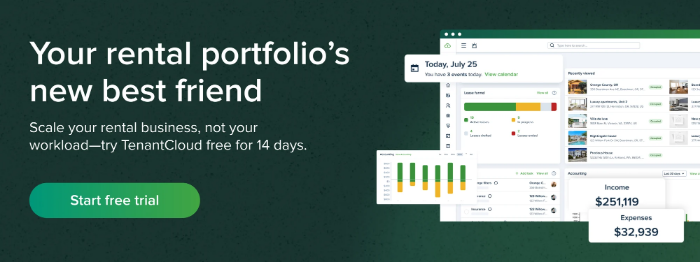
TenantCloud grows with you either way: from a solo landlord with two single family homes to a property management company managing properties for dozens of owners, the platform scales to match where you are and where you're headed.
Ready to see how it works? Start your free 14-day TenantCloud trial today and find out how much easier managing your rental business can be.
Frequently Asked Questions
What does a property management company do?
A property management company handles day-to-day rental operations on behalf of the owner, from marketing vacancies and screening tenants to coordinating maintenance and providing financial reporting.
How much does a property management company charge?
Most companies charge 8-12% of monthly rent, plus a leasing fee of 50-100% of one month's rent when a new tenant is placed. Additional fees for renewals, maintenance, and evictions can increase total annual costs.
Is a property management company worth it?
It depends. Professional management makes sense if you own multiple properties, live far from your rental, or are uncomfortable navigating legal compliance. For local landlords managing one or two homes, self-management with the right tools is often the most cost-effective choice.
Can I manage my rental property without a property management company?
Yes, many landlords do. Platforms like TenantCloud handle many of the tasks that a property manager would, making self-management more straightforward.
Does TenantCloud work for property management companies?
Yes. TenantCloud's Pro plan includes features built for companies managing properties on behalf of multiple owners, as well as individual landlords at any portfolio size.


