

As any experienced landlord knows, just a single bad placement – one tenant who stops paying rent, damages their unit, or triggers an eviction – can cost thousands of dollars and months of lost time to remediate. This is why tenant screening isn’t optional – it’s one of the most consequential decisions a landlord can make.
This has always been vital, but the legal environment has brought new regulations that impact this process, including state-level rules around application fees, portable screening reports, and criminal history. At the same time, screening technology has gotten sharper, moving beyond a basic credit pull to encompass a process that can include identity verification, income analysis (no more dealing with fake pay stubs!), and even new ResidentScore models through TransUnion that predict rental outcomes more accurately than a raw FICO number ever could.
Whether you own two units or two hundred, finding the best tenant screening service means balancing cost, depth of data, speed, and legal compliance. This guide covers all of it.
TL;DR
Picking the right tenant screening service matters more than ever. New state laws govern when fees can be charged, how applications must be processed, and whether portable screening reports must be accepted. This guide breaks down the nine best services, covers the key legal updates every landlord needs to know, and explains how to weave screening into your broader property management workflow.
Why You Need the Best Tenant Screening Services for Small Landlords
For the independent landlord managing a handful of units, every vacancy is significant. You don’t have a property management or enterprise legal team to handle an eviction or maintenance department to absorb the time and cost of a trashed unit – it’s just you.
A solid tenant background check doesn't just confirm someone can pay the rent. It surfaces eviction history, flags identity fraud, verifies income, and gives you a fuller picture of how a person has treated prior landlords.
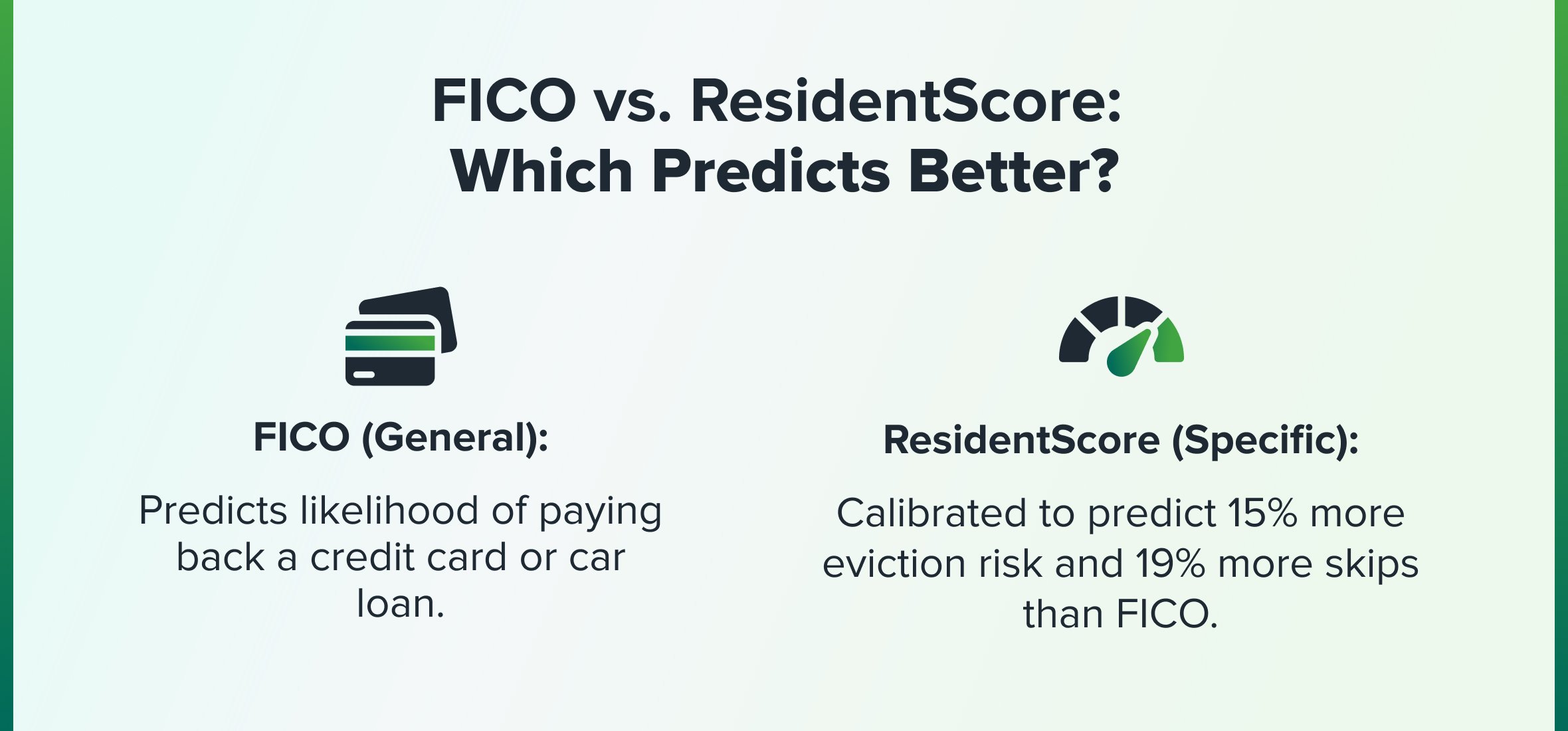
The difference between a standard credit score and something like TransUnion's ResidentScore is meaningful: the ResidentScore is built specifically for the rental context, weighing factors that predict whether someone will pay rent and leave a unit in good condition, not just whether they manage can a credit card responsibly.
There's also the compliance angle. Federal law under the Fair Credit Reporting Act (FCRA) sets baseline requirements for how consumer data may be used in tenancy decisions. Layered on top of that are state and local laws that change year to year.
A reputable screening service keeps you on the right side of those rules without requiring you to spend hours figuring it out on your own.
Top 9 Tenant Screening Services: An In-Depth Comparison
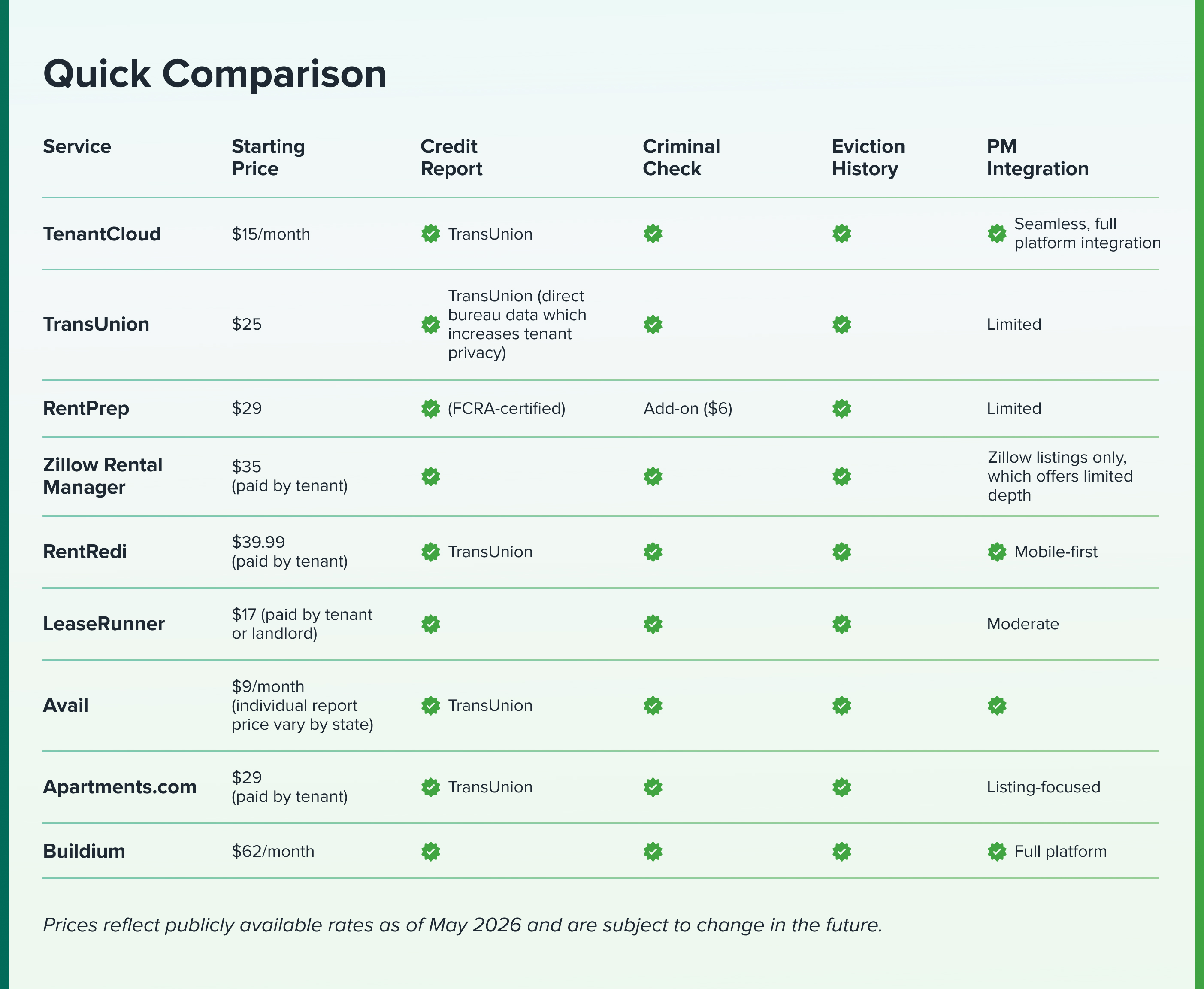
Fortunately, there are many tenant screening services that can offer both compliance compatibility and useful, actionable insights. The challenge for smaller landlords is figuring out which service works best for their needs. Here’s a quick breakdown of the services that are available today.
1. TenantCloud
TenantCloud earns the top spot not just for its screening depth, but because it solves the biggest logistical problem for small and mid-size landlords: keeping everything in one place.
When an applicant fills out a rental application through TenantCloud, you can launch a full background check directly from that record. You don’t need to re-enter names, copy and paste, or even open a new tab.
The Full Check package ($40) is powered by TransUnion and covers:
- A comprehensive credit report
- ResidentScore
- Nationwide criminal background check
- Sex offender registry search
- Eviction history
A Premium tier adds $5 for deeper identity verification and income analysis.
Beyond screening, TenantCloud handles everything from online rent collection and maintenance requests to lease signing, and accounting. This ensures screening is the first step in a comprehensive workflow, not a disconnected step.
Best for: Landlords who want screening integrated with full property management.
2. TransUnion SmartMove
SmartMove delivers accurate, actionable data straight from TransUnion. Since the tenant receives an invitation and consents directly, the landlord never handles sensitive personal information, which makes FCRA compliance a lot simpler.
Pricing runs from $25 (SmartCheck Basic) to $44 (SmartCheck Pro). The tradeoff is there is no property management integration – it's a standalone tool that adds a manual step to any existing workflow.
Best for: Landlords who want direct bureau data without a full platform subscription.
3. RentPrep
RentPrep uses FCRA-certified screeners who manually review reports before delivery, adding a human layer that catches inconsistencies in criminal record data that automated systems can sometimes miss.
Pricing for this system is modular: a basic package starts at $21 and covers:
- Identity verification
- Eviction
- Bankruptcy
- Credit summary
Criminal searches are available as an add-on for $6, while a full credit report is $40.
RentPrep also generates FCRA-compliant adverse action letters, which landlords are legally required to send when denying an applicant based on a consumer report.
Best for: Landlords who value manual review and modular pricing.
4. Zillow Rental Manager
Zillow's platform brings listing exposure to a massive audience, and the $35 TransUnion screening report (paid by the tenant) is functional, covering:
- Credit history
- Criminal history
- Past evictions
Where it falls short is depth and flexibility. There is only one package available, with no customization options or integrations with external tools.
If you only list on Zillow and want to keep things simple, it works. However, if you need income verification or portable report compliance features, you will likely outgrow this option quickly.
Best for: Landlords primarily marketing on Zillow who want a built-in, no-fuss option.
5. RentRedi
RentRedi leads with a mobile-first experience for both landlords and tenants. Applicants can complete and submit screening requests from their phones in minutes, reducing drop-off during the application process.
Screening is powered by TransUnion and costs $39.99, covering credit, criminal, and eviction reports.
The mobile design works especially well for landlords managing properties on the go. However, the tradeoff is that desktop functionality and accounting depth are seriously lacking compared to more comprehensive platforms.
Best for: Landlords who prefer managing everything from a smartphone.
6–9: LeaseRunner, Avail, Apartments.com, Buildium
LeaseRunner bundles screening with lease generation and e-signatures, which is useful for landlords who want those two functions linked without paying for a full property management suite. It also offers state-specific compliance tools that matter in legally complex markets like California and New York.
Avail has built a following among first-time landlords for its guided workflows and educational resources. Screening runs $30–$55 with TransUnion data, and a free plan lets landlords shift the cost to applicants. It's an approachable starting point before graduating to a more full-featured platform.
Apartments.com keeps screening simple: a $29 tenant-paid fee gets you a screening that uses TransUnion data. It works cleanly if you're already listing there, but doesn't offer income verification or any more actionable data.
Buildium is purpose-built for professional property managers and larger portfolios. Screening is bundled into the platform subscription alongside deep accounting, owner reporting, and team management tools. For a landlord with two or three units, the cost structure may feel top-heavy, but for a management company overseeing dozens of units, it definitely earns its place in your technology stack.
Legal Updates: Navigating Tenant Background Check Laws
Tenant screening law has become one of the fastest-moving areas of landlord-tenant regulation. Failing to stay informed won’t just hurt your bottom line – it can also put you at risk for compliance and regulatory scrutiny that no one wants to deal with. To stay on top of things, here’s a quick rundown of what landlords need to know.
California AB 2493: Application Fee Rules Tightened
Effective January 1, 2025, California's AB 2493 changed how landlords can collect screening fees under Civil Code §1950.6. You can only charge a fee when a unit is actually available, which means that collecting fees speculatively for future vacancies is no longer permitted.
Once you collect fees, you must follow one of two approved methods. Under the first-come, first-considered approach, you review applications in the order received with written screening criteria disclosed upfront.
Alternatively, you can review in any order but must refund 100% of the screening fee to every applicant you don't select, within seven days of making a selection or 30 days of receiving the application, whichever comes first.
Regardless of which method you use, applicants who pay a fee must receive a copy of their credit report within seven days of you receiving it. The current fee cap sits at approximately $66 per applicant for 2025, adjusted annually from the original $30 baseline.
Portable Tenant Screening Reports
At least seven states have enacted laws that either encourage or require landlords to accept valid portable tenant screening reports (PTSRs) submitted by applicants.
- In California, according to their new law AB 2559, if a tenant provides a compliant PTSR that meets FCRA standards and is less than 30 days old, you cannot charge a separate application fee.
- Colorado's HB25-1236, effective January 1, 2026, makes acceptance mandatory and sets civil penalties up to $2,500 for noncompliance.
- Maryland and Washington require landlords to notify applicants whether they accept portable reports.
- Vermont bans application fees entirely.
The direction is clear: landlords need documented processes for handling applicant-provided reports.
New York: $20 Cap and the Fair Chance for Housing Act
New York State caps application fees at the actual cost of the check or $20 (whichever is lower) under Real Property Law §238-a. If a tenant provides a portable report issued within the past 30 days, the fee must be waived entirely.
New York City added the Fair Chance for Housing Act (Local Law 24) on January 1, 2025. Under this law, landlords cannot consider criminal history until after conditionally approving an applicant based on all other qualifications. Only certain convictions can then be considered, which include:
- Felonies within the past five years
- Misdemeanors within the past three years
If a denial follows, landlords must provide a written explanation and give the applicant five business days to respond.
Fair Chance Act Enforcement: No More Blanket Criminal Bans
Across multiple jurisdictions, blanket policies that automatically disqualify any applicant with a criminal record are under increased regulatory scrutiny.
The Fair Housing Act's disparate impact standard applies. This means that if a criminal exclusion disproportionately screens out applicants in a protected class, it can trigger a complaint.
The practical requirement is individualized assessment, requiring landlords to weigh the nature and severity of the offense, time elapsed, evidence of rehabilitation, and specific risk to the property.
Key Features to Look for in a Renter Background Check
For landlords looking to improve how they evaluate background checks or ensure their individualized assessment is compliant, let’s look at the key features of a background check that offer the most information.
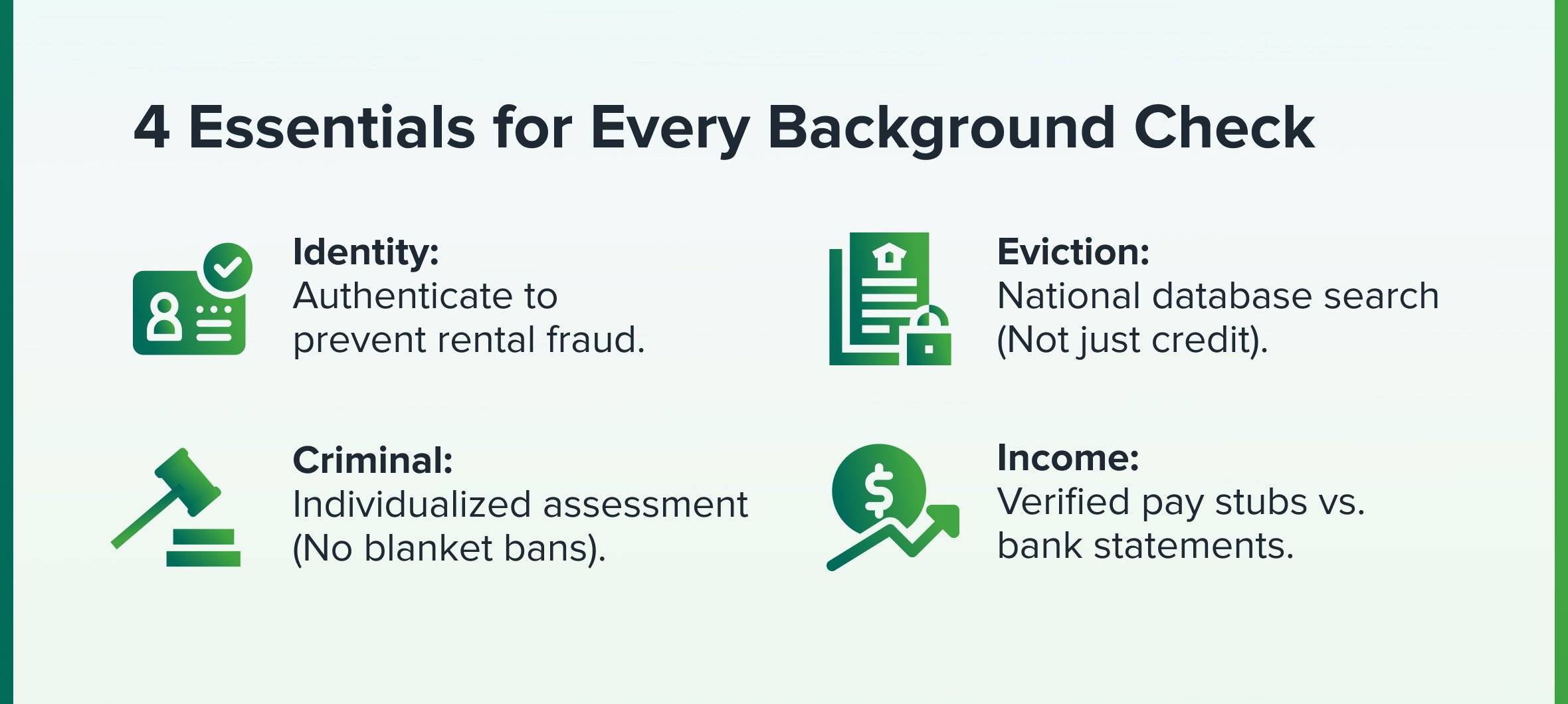
- Rental-specific scoring. A standard credit score measures general creditworthiness. A ResidentScore or equivalent rental-specific model is calibrated to predict whether someone will pay rent consistently and treat the property well, which is a much more useful signal for landlords than a raw FICO number.
- Dedicated eviction search. Eviction records aren't reliably captured in standard credit pulls. Services that search eviction-specific court databases give you data you might otherwise miss entirely.
- Nationwide criminal background check. County-by-county searches leave gaps. Multi-state and nationwide criminal database searches provide broader coverage.
- Income and identity verification. A credit score describes past behavior, but income verification will give you accurate data on present capacity. Additionally, identity authentication has become increasingly important as rental fraud rises.
How Property Managers Can Streamline Tenant Screening Services
For property managers running other people's assets as a business, screening is a core liability management function. One negligent placement claim can cost more than a year of management fees, and eat up time that would be better spent building positive relationships with existing tenants.
The most efficient property managers build screening directly into their intake workflow so it can't be skipped. A platform like TenantCloud makes this simple. As applications arrive through syndicated listings, screening can be launched from the same account, with results fed directly into the lease and rent collection workflow. This ensures:
- No duplicate data entry
- No misfiled PDFs
- No broken chain of documentation

For portfolios spanning multiple states, staying current on state-specific regulations and fee restrictions is increasingly demanding. A property management platform that monitors these changes and builds compliance directly into the workflow reduces that burden substantially.
Plus, faster screening usually means faster placement. Every day a unit sits vacant is lost income. When reports come back in minutes and can be shared securely with property owners from inside the platform, the whole leasing cycle tightens.
Conclusion & Next Steps
Good tenant screening is about making a fair, informed, and compliant decision with the best available data. The services reviewed here each do that job well, but each have their own best use cases that make them ideal for different landlords in different circumstances.
For most independent landlords and property managers, the strongest option connects screening to the rest of your rental operation. When applications, reports, leases, and payments all live in the same platform, errors go down and time savings add up.
TenantCloud's Full Check screening, powered by TransUnion, delivers the depth of data you need at a competitive price – and it's built into a platform that handles the rest of your rental business alongside it.
Start with a 14-day free trial today to see how easy it is when better screening lives inside your workflow.
Frequently Asked Questions
What is the most important thing to check in a tenant background check?
Eviction history is often the most predictive indicator. A tenant can have an average credit score and still be a reliable renter, so a recent eviction is a much stronger warning sign. The best services run dedicated eviction database searches rather than relying on credit reports alone to surface this data.
Can landlords require tenants to pay for their own screening?
In most states, yes. However, some states cap total fees or requires refunds to unselected applicants.
What is a portable tenant screening report (PTSR)?
A PTSR is a report the applicant purchases themselves and shares with multiple landlords, avoiding repeated fees during their housing search. At least seven states have enacted PTSR laws.
How do Fair Chance laws affect tenant screening?
Fair Chance laws, which are now in effect in New York City, Seattle, and other jurisdictions, restrict when landlords can consider criminal history. Generally, criminal records cannot be reviewed first. Landlords must evaluate other qualifications before conducting an individualized assessment of any conviction history. Within these jurisdictions, blanket exclusions based solely on a criminal record are not permitted.
What's the difference between a credit score and a ResidentScore?
A standard FICO score predicts general credit risk. TransUnion's ResidentScore is built specifically for the rental market, weighting factors that predict rental-specific outcomes like consistent rent payment and property care.
Is tenant screening legally required?
No. But using a consumer report to make a tenancy decision does trigger FCRA obligations, including written consent, adverse action procedures if you deny someone, and use of an FCRA-compliant service.


