
TL;DR
- Outdated methods (cash, checks, P2P apps) create documentation gaps, legal exposure, and unnecessary monthly busywork.
- Offline payers are 23% more likely to pay late. Switching to digital solves both the paper trail and renter experience problems at once.
- Venmo, Zelle, and Cash App aren't built for rent. They have no late-fee mechanism, no dispute resolution, and no lease-linked records that hold up in court.
- Automated rent collection runs billing, reminders, late fees, and receipts on a fixed schedule with no monthly action required from either party.
- Setup takes five steps: Pick a platform, enter lease details, enroll tenants in auto-pay, set reminders, and connect a bank account.
- When rent is late, follow a documented timeline (reminder, late fee, written notice, then formal eviction proceedings) and keep everything in writing.
Collecting rent consumes far more time and mental energy than it should for landlords using outdated methods. Chasing checks, making bank runs, and reconstructing payment records at tax time all pull valuable attention away from the difference-making work that grows a rental business.
The best way to collect rent as a landlord is an automated system that handles billing, reminders, late fees, and recordkeeping on a fixed schedule, with no manual action required each month.
Online rent collection platforms do exactly that, and they’re accessible enough that a landlord managing a single unit can set one up in a few minutes. Below, we’ll compare 8 rent collection methods side by side, list platforms worth considering, provide a step-by-step setup guide for automating rent collection, and outline a foolproof action plan for when a tenant doesn’t pay.
Why Your Rent Collection Method Matters
73% of renters prefer digital payment options, and the reason is obvious: online payments are faster, easier to track, and easier to automate. A landlord who requires cash or checks signals a seat-of-the-pants operation, a perception that could scare away solid applicants.
The payment methods you accept also shape cash flow, documentation, and monthly workload. Landlords running scattered operations with little to no paper trail (cash payments logged in a notebook, checks deposited when there’s time) deal with the same issues on repeat: disputed payments, missed deposits, and a monthly rent chase that’s taxing across even a small portfolio.
The documentation gap hits hardest when legal disputes arise. Say a landlord who collects rent through Venmo ends up in court over nonpayment. Venmo shows money moved, but it does not tie each transfer to the lease, rent ledger, late-fee history, or the month the payment was supposed to cover. Housing courts often need that context to verify the timing and purpose of each payment.
Moving to online rent collection solves both the paper-trail problem and the renter-experience problem at once.
Best Way to Collect Rent as a Landlord: Top 8
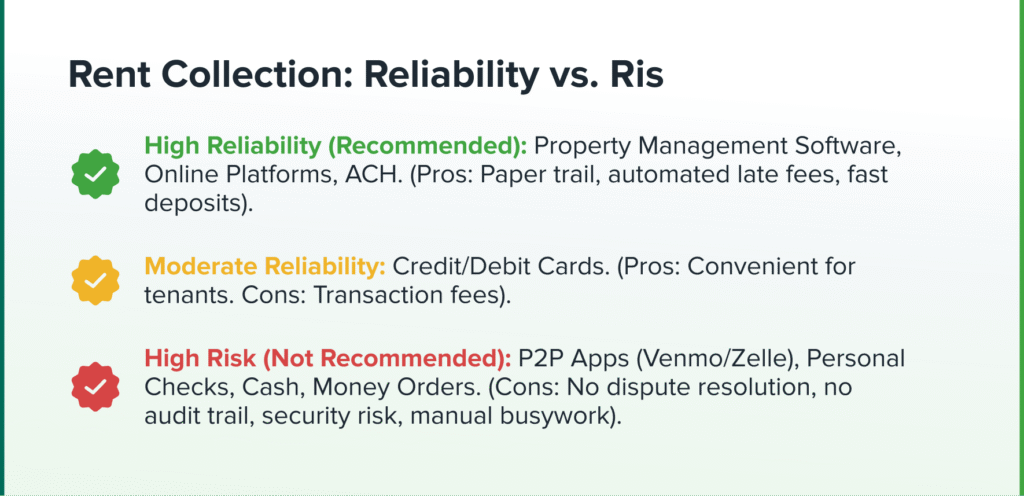
Each method below carries different costs, risks, and trade-offs. The ranking reflects reliability and documentation quality, not convenience.
1. Property Management Software with Built-In Rent Collection
Property management software that bundles rent collection with state-specific lease agreements, maintenance tracking, and accounting eliminates the need for separate tools. For landlords managing multiple units, consolidating tasks into one platform saves time, keeps records in sync, and reduces mistakes that arise from juggling payments, repairs, leases, and bookkeeping across multiple systems.
2. Online Rent Collection Platforms
Purpose-built rent collection tools, such as PayRent, handle billing, late fees, reminders, payment records, and deposits within a single system. A document-first platform ties each payment to a timestamped receipt and tenant record, which helps during tax prep, deposit disputes, and eviction proceedings.
While rent-only platforms can streamline payments, landlords must manage leases, maintenance, accounting, and tenant records elsewhere, leaving them to connect the dots manually.
3. ACH
ACH (Automated Clearing House) transactions move funds directly from the tenant’s bank account. Processing fees typically range from $0 to $3 per transaction, and settlement takes 1 to 3 business days. Reliable and low-cost, ACH is the dominant electronic method for recurring rent collection and comes standard with most property management software platforms.
4. Credit and Debit Card Payments
Credit and debit card payments often clear within 1 to 2 business days, giving tenants flexibility when cash is tight. Processing fees (usually 2.5% to 3.5% of the rent amount) are typically passed through to the tenant. This option can work well for tenants who want short-term payment flexibility or to collect rewards on a monthly bill they already have to pay.
5. Cash
Cash isn’t king in the world of rent collection.
It carries zero transaction fees but maximum operational risk. Without a paper trail, a single disputed payment can become an unresolvable he-said, she-said disagreement. Transporting cash rent payments from a unit to a bank also creates a security risk that the other methods on this list avoid entirely.
6. Personal Checks
Checks require an in-person or mail handoff every month, carry a bounce risk that triggers banking fees and delays, and offer no automation for late fees or reminders. Paying with checks adds friction on both sides of the transaction without producing any documentation that a dedicated platform would handle automatically.
7. Peer-to-Peer Apps (Zelle, Venmo, Cash App, PayPal)
Peer-to-peer apps move money quickly and easily, but weren’t designed for landlord-tenant rent collection. For instance, Zelle has no late fee mechanism, no dispute resolution for rent, and no paper trail tied to a lease. Not to mention, payment reversals can happen well after a transfer clears.
Venmo, Cash App, and PayPal carry the same issues: no lease-linked records, no dispute resolution, and no integrated documentation that holds up in a security deposit dispute or eviction proceeding.
8. Money Orders and Cashier's Checks
Money orders and cashier’s checks are more secure than cash and personal checks, but still don’t solve the monthly friction problem. These payment methods can make sense for collecting a security deposit or the first month’s rent from a high-risk applicant. As a recurring method, however, they add logistical steps without providing any of the automation or documentation that an online platform would deliver.
What is automated rent collection?
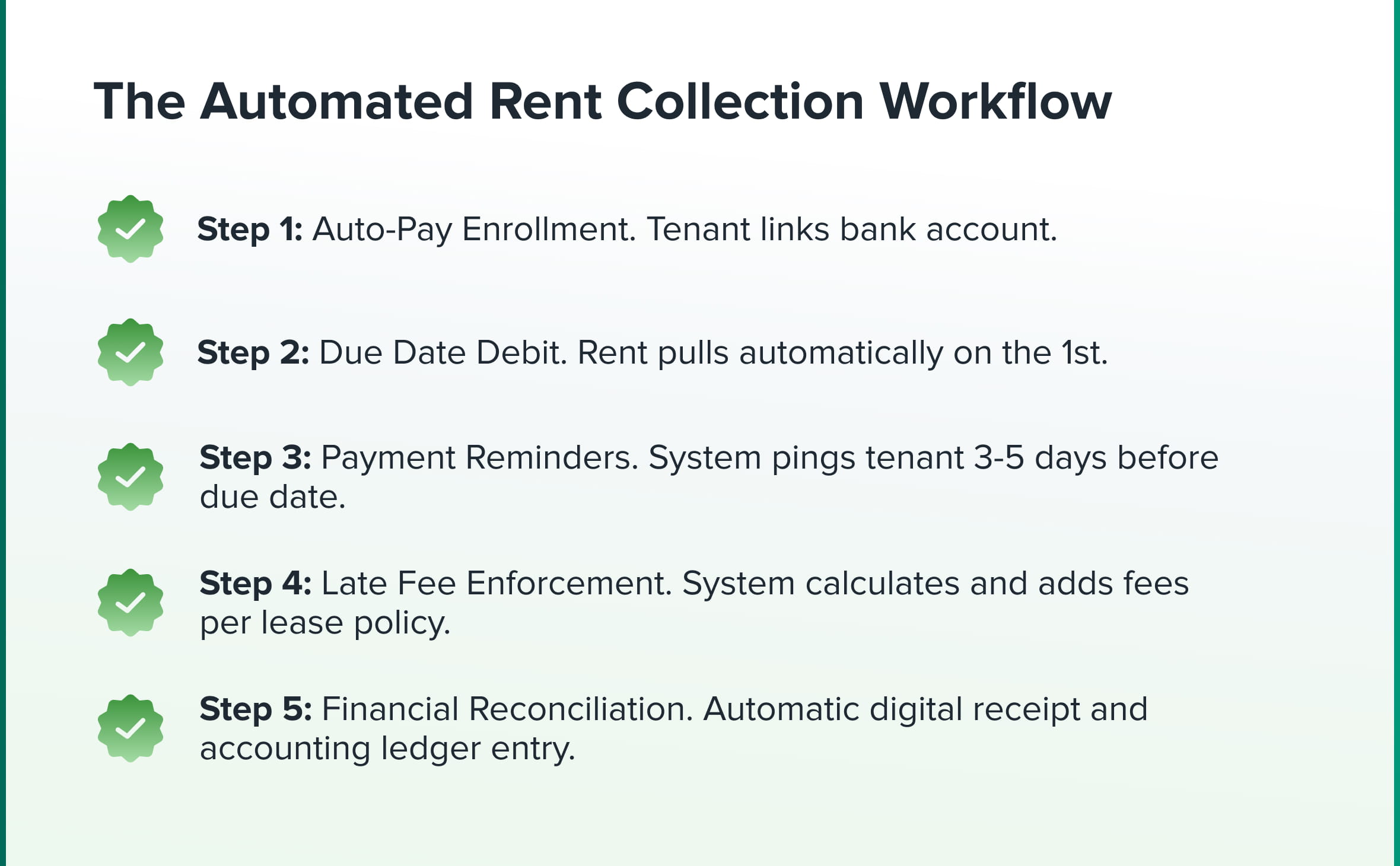
Automated rent collection is a scheduled pull from the tenant’s bank account or card on file on the due date each month, requiring no action from the landlord or tenant once the system is configured.
The full automation stack includes:
- Auto-pay enrollment,
- A monthly debit on the due date,
- Pre-due reminders (typically 3-5 days before),
- Automatic late fee assessment, and
- Timestamped receipts for every transaction.
Dedicated platforms process rent through PCI-compliant payment gateways with encrypted transactions. Some platforms also offer rent reporting to credit bureaus, which gives tenants a financial incentive to pay on time.
How to Automate Rent Collection in 5 Steps
Setting up automated rent collection is quick and easy. These steps apply to most online rent collection platforms:
Step 1: Choose a Rent Collection Platform That Fits Your Portfolio
Match the tool to your portfolio size. Entry-level plans work for 1-4 units. Mid-tier platforms handle 5-50 units and include accounting export, multi-property dashboards, and more granular late fee controls. TenantCloud’s 14-day free trial covers the full feature set.
Step 2: Add Tenant and Lease Details
Enter each tenant’s name, lease start and end dates, rent amount, due date, and late fee policy per the signed lease. Accuracy here is essential, as the platform will generate invoices, assess late fees, and calculate balances from these details. Setup errors almost always lead to billing errors.
Step 3: Enroll Tenants in Auto-Pay
Send each tenant the auto-pay setup link. After they click through, they’ll enter their bank or card details and authorize a recurring payment. Diligent landlords make auto-pay enrollment a lease condition rather than a tenant option, removing the monthly variable before move-in.
Step 4: Configure Automated Reminders
Set at least 3 rent reminders: 3-5 days before the due date, on the due date, and 1 day after if the rent is unpaid. Reminders serve as both a prevention tool and a recovery mechanism.
Of tenants who missed the due date and received a reminder, 58% paid within the grace period, per RentRedi’s data. Without a reminder, only 38% paid within the window.
Step 5: Connect Your Bank Account and Test
To receive deposits, you’ll need to link a bank account to the rent collection platform. After you’ve linked your account, run a $1 test transaction before going live with real rent to confirm the connection works on both sides. Most ACH transactions should hit your account within 2-3 business days.
Best Rent Collection Apps and Software for Landlords
Portfolio size is the right starting point when choosing the best rent collection software. What a two-unit landlord needs from a rent collection app is different from what a 30-unit portfolio manager requires.
TenantCloud
TenantCloud is a process-driven, all-in-one property management platform. Paid plans cover rent collection, tenant screening, lease generation, accounting, an AI Assistant, and more. Tenants enrolled in credit bureau rent reporting enjoy $0 ACH fees, a practical incentive for landlords managing 1-50 units.
Other Platforms to Consider
TurboTenant suits small landlords who want rent collection, tenant screening, maintenance management, and applications in a single flow. Zillow Rental Manager and Apartments.com offer free rent collection within their listing ecosystems, but neither includes accounting, which limits their usefulness as standalone solutions.
RentRedi charges a flat monthly fee regardless of unit count, making it more cost-effective than per-unit pricing once a portfolio clears 15-20 units. Buildium and AppFolio are built for landlords managing properties on behalf of investors, with owner portals and financial reporting that owner-operators typically don’t need.
One note applies across all platforms: “Free” rent collection at the landlord level typically means the tenant absorbs a small ACH or credit/debit card processing fee. Always check a platform’s pricing page before presenting any service to tenants as a zero-cost option.
What to Look For in a Rent Collection Service
Finding the best way to collect rent as a landlord means working through a short list of operational factors. Each of the following affects the landlord-tenant relationship every month:
Cost structure: Determine whether fees fall on the landlord, the tenant, or both. A flat $0.25 ACH fee and a 2.75% card fee affect the budget very differently at scale.
Deposit speed: The gap between 1-business-day and 5-business-day settlement creates real cash flow differences across a multi-unit rent roll.
Automated late fees: The platform should assess and apply late fees per the lease policy each month, without any manual action required from the landlord.
Rent reporting: Credit bureau reporting gives tenants a credit-building incentive to pay on time, at no direct cost to the landlord.
Accounting integration: Exporting to QuickBooks or a built-in ledger, integrated accounting tools can save hours at tax time and keep your rent roll organized year-round.
Security and compliance: Above-board, PCI-compliant payment processing and encrypted transactions should come standard on any platform worth considering.
How to Handle Late or Missed Rent
Even a well-automated system will surface a few late-paying tenants. The approach below reflects how a by-the-book, compliance-minded landlord would handle the timeline, whether the tenant is a first-time late-payer or habitually tardy.
- Days 1-3: Send a polite automated reminder. Hold off on formal action unless the lease specifies a day-1 late fee.
- Days 4-5: Assess the late fee per the lease. Follow up with a matter-of-fact written message confirming the fee has been added and listing available payment options.
- Days 7-10: Serve a written Notice to Pay or Quit within the state-specific notice window. Keep all communication in writing from this point forward.
- Day 14+: Begin the formal eviction process once a tenant is rent delinquent beyond Day 14, as permitted by state law. Consult an attorney before filing.
Throughout the nonpayment process, document every reminder, partial payment, and conversation. Property management software platforms often automatically log these interactions, which creates a clear record if the situation escalates.
Important legal note: Notice periods, fee limits, and eviction procedures vary by state, so confirm your state’s laws before taking any of the steps above. Self-help eviction (changing locks, shutting off utilities, removing a tenant’s belongings, etc.) is illegal across the country and creates real liability.
Turn Rent Day Into a Non-Event
Landlords with the most predictable, cash-flowing properties typically build a collection system once and stop managing payments manually altogether.
TenantCloud’s rent collection system covers the full cycle:
- Automated billing
- Payment reminders
- ACH and card payments
- Late-fee enforcement
- Digital receipts
- Deposit tracking
- Built-in accounting integration
Getting started won’t take long. First, add your lease details. Next, send the auto-pay link to your tenants. Last, connect your bank account and customize your rent reminder sequence.
From there, the system will handle the monthly payment workflow while building a clean, timestamped record for tax reporting, tenant disputes, and day-to-day portfolio management.
Sign up for a free 14-day TenantCloud trial that includes the full feature set, with no commitment required.
Frequently Asked Questions
What is the best way to collect rent as a landlord?
The best way to collect rent as a landlord depends on the size of your portfolio.
For 1-4 units, a platform with auto-pay and automated late fees covers the essentials. For 5-50 units, an all-in-one system with accounting and lease documents is worth the monthly fee. Beyond 50 units, advanced tools with owner reporting and portfolio-level accounting can justify the added cost.
How do landlords set up online rent payments for non-tech-savvy tenants?
The simplest way to set up online rent payments for non-tech-savvy tenants is to use a platform with a simple interface and clear guidance. TenantCloud’s tenant portal is designed for ease of use, making it accessible even for renters with limited technical experience.
How do I collect rent from tenants electronically?
Choose a platform, add tenant and lease details, send the auto-pay enrollment link, configure automated reminders, and connect your bank account. Before the first rent due date, confirm that each tenant has accepted the invite and selected their preferred payment method.
What is the best online rent payment system for landlords?
The most reliable online rent payment systems combine secure processing, automated rent reminders, and real-time tracking. TenantCloud combines these features into one single platform, helping landlords stay organized and reduce missed or late payments.
How can landlords stop accepting cash and checks for rent safely?
Landlords can safely stop accepting cash and checks by offering a secure online rent payment option for tenants with clear expectations. With TenantCloud, tenants can pay through a secure portal, creating a reliable payment record while minimizing risk for both parties.
Is online rent collection secure for landlords and tenants?
Online rent collection is generally more secure than cash or checks when handled through a trusted platform. Reputable systems use bank-level encryption, secure payment gateways, and fraud prevention tools to protect both landlord and tenant data, while reducing the risk of lost or altered payments.
TenantCloud processes payments through PCI-compliant providers and automatically records each transaction, creating a clear audit trail and improving overall payment security.
How can landlords switch from checks to online rent collection?
The easiest way to switch from checks to online rent collection is to introduce digital payments gradually and clearly communicate the benefits. Highlight advantages like faster payments, fewer late fees, and improved payment records, then provide a straightforward way for tenants to pay online.
TenantCloud helps simplify this transition by giving tenants a secure portal to pay rent from their phone, set up recurring payments, and receive automatic confirmations. For landlords, this means less manual follow-up and better organization.
What’s the cheapest way to collect rent online?
ACH transactions typically run $0 to $3 per transfer, making them among the lowest-cost electronic methods. TenantCloud offers $0 ACH fees for tenants enrolled in rent reporting to credit bureaus. Card processing carries a 2.5 to 3.5% fee on the overall rent, which is typically passed through to the tenant rather than absorbed by the landlord.
Is Zelle a good way to collect rent?
While fast and convenient, Zelle is not a good choice for rent collection. The platform has no late-fee mechanism, no dispute-resolution process for rent payments, and no paper trail tied to a lease agreement. Zelle can leave landlords piecing together bank activity when they need a clean rent ledger.
What low-cost rent collection tools work for small portfolios?
Small landlords mostly benefit from simple, all-in-one rent collection tools. Platforms like TenantCloud are built for portfolios of any size, supporting online payments, rent reminders, and financial reporting for even small, DIY landlords.