

Evictions can be stressful for renters as they lose the roof above their heads. But they’re equally challenging for landlords.
When you file for an eviction, you stand to lose more than just unpaid rent. It’s estimated that landlords spend the equivalent of 2-3 months of rent on evictions. And that’s just the financial side.
The constant stress and uncertainty of a legal battle can cause headaches for landlords, all while your property remains in limbo.
A cash for keys agreement helps avoid this long-winded process and speeds up the path to getting the keys to your property back, minus the stress.
Let’s understand what it’s all about and why you should consider it as a landlord or property manager.
What is a Cash for Keys Agreement?
A cash for keys agreement, also called keys for cash, is a legally binding contract that involves the landlord paying the tenant to voluntarily move out of the property.
Unlike an eviction, this is a mutual agreement that protects the rights of both the landlord and the tenant.
Evictions are slow, unpredictable, and stressful. They could also lead to discord between the landlord and the tenant. This type of agreement, one of the basics of becoming a landlord, helps eliminate these issues before they start.
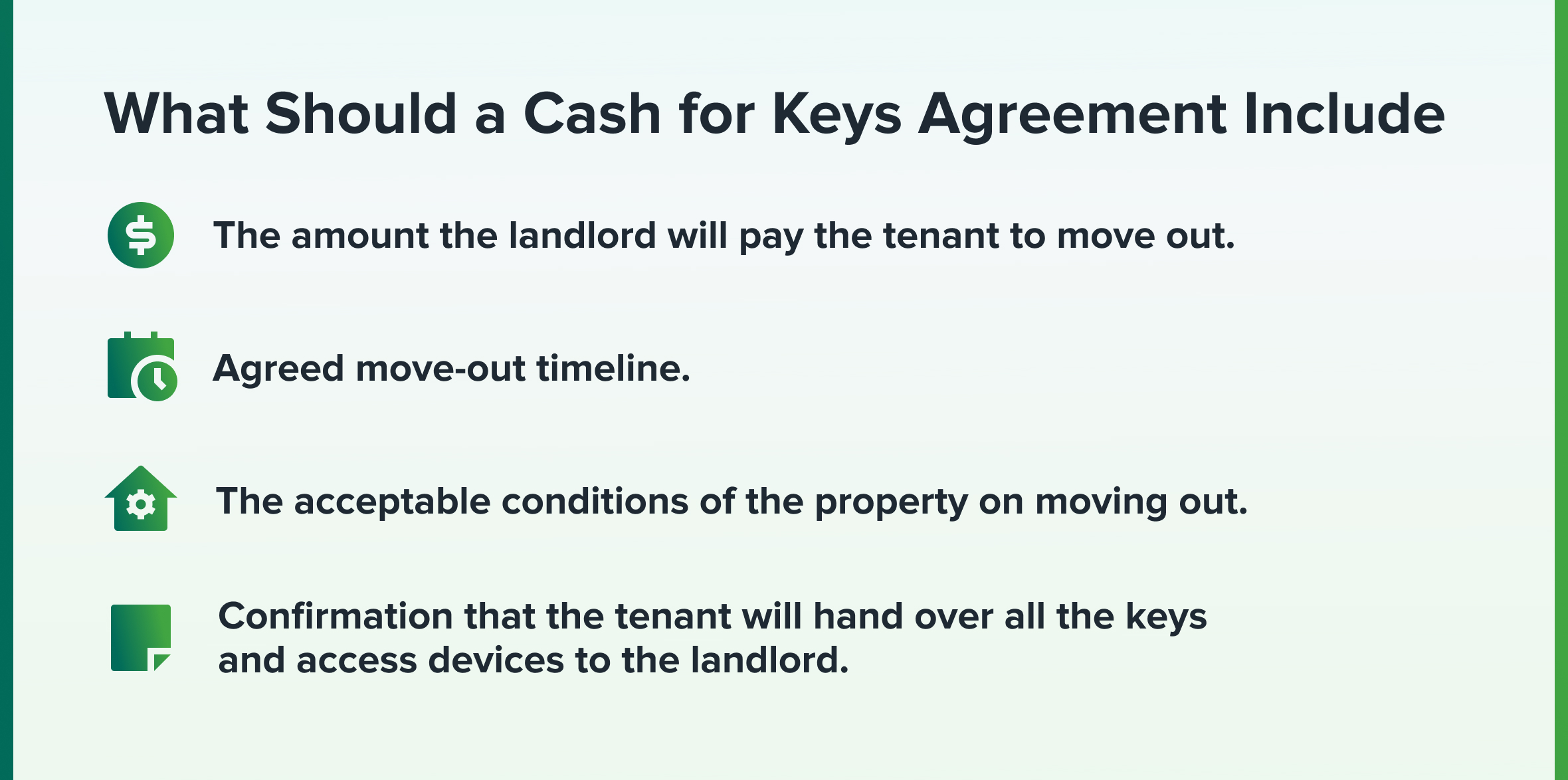
Typically, this agreement includes:
- The amount the landlord will pay the tenant to move out.
- Agreed move-out timeline.
- The acceptable conditions of the property on moving out.
- Confirmation that the tenant will hand over all the keys and access devices to the landlord.
Now, paying the tenant for moving out might feel counterintuitive. But when you sum up the eviction expenses and stress, cash for keys is often the most efficient option.
Why Landlords Use a Cash for Keys Agreement
Cash for keys is used when landlords want possession of their property back and are in a position to negotiate with the tenant.
Common scenarios where they’re used include:
- Non-payment of rent
- Lease violations
- Planned renovations or sale
- Need to raise rent to market rate
But why is a cash for keys agreement preferred over eviction?
The main reason here is cost. On average, evictions can cost $3000 just to start. Properties may also remain vacant after eviction, resulting in lost rental income. But having an agreement is faster and often cheaper.

For example, an agreement might include a scenario in which renters receive funds to help them relocate to another property. This helps them avoid an eviction, which could land on their record, while helping them secure future housing.
Paying the tenant to vacate the property may seem like a reward for bad behavior. Instead, think of it as a cost-benefit decision you can use to your advantage to avoid the eviction process.
Cash for Keys vs. Eviction: Cost and Timeline Comparison
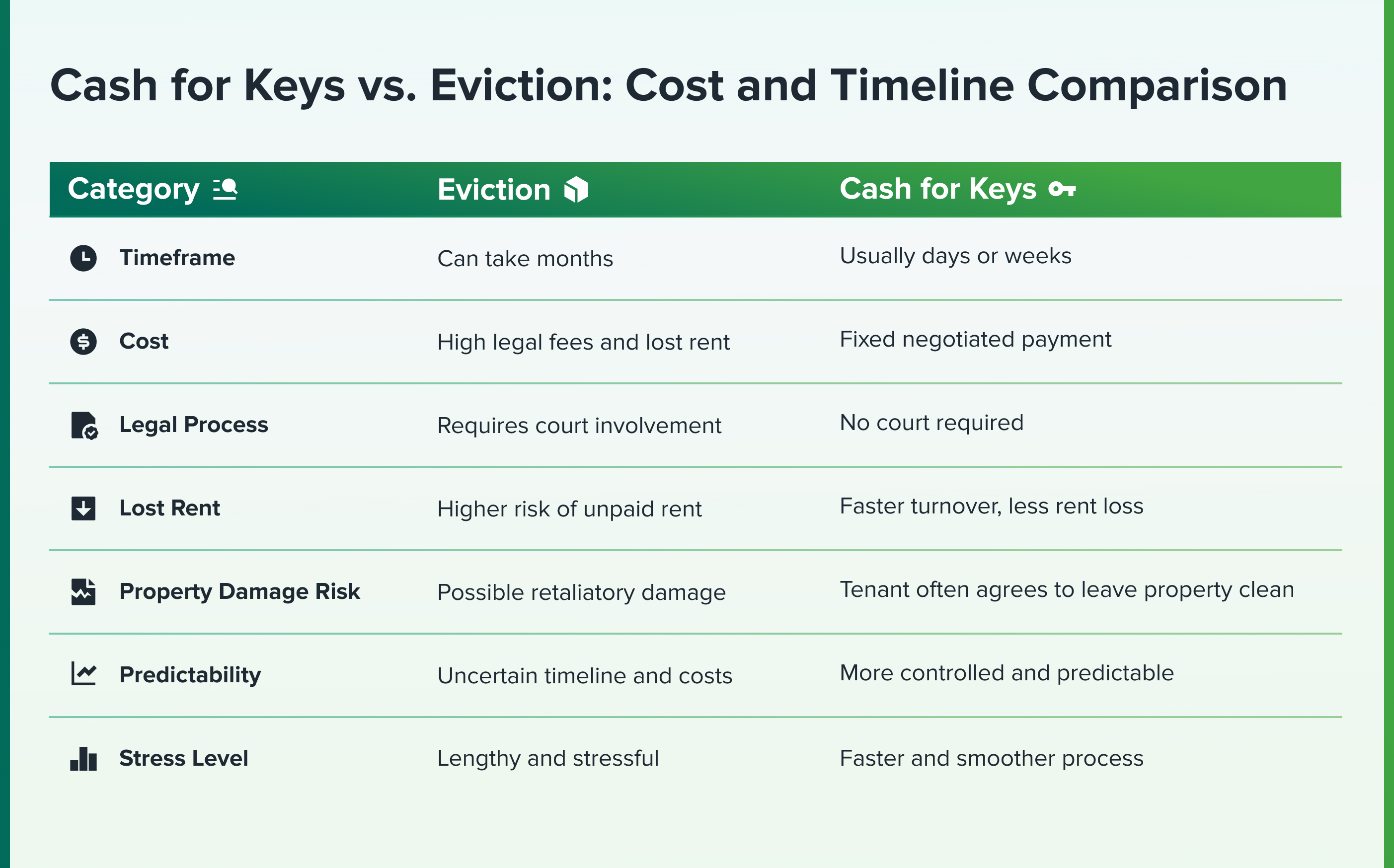
Evictions may seem like the right way to regain possession of your property when a tenant damages it or fails to pay rent when it's due. But that's not always the case. Here’s how they stack up:
Eviction
Evictions involve court filings, judicial oversight, and statutory notices. As it’s a state-sanctioned mechanism for reclaiming your property, it’s rarely fast.
- Evictions can take months to complete, depending on your local regulations and court backlogs.
- Long cases mean high legal costs that can quickly balloon up.
- Lengthy process means losing rent for several months.
- There’s always a risk of retaliatory damage by the tenant who’s set to be evicted.
Cash for Keys
Cash for keys avoids court involvement, allowing landlords and tenants to resolve the matter directly.
- Cash for keys agreements are resolved in days to weeks, as there’s no legal delay.
- Tends to cost much less than evictions, even though the amount is paid up front. The fee is fixed and negotiated with the tenant beforehand.
- You don’t lose out on rent due to long-winded eviction proceedings.
- Payment is usually tied to the tenant leaving the property in a clean condition.
- The entire situation, including the financial losses, is controlled and predictable.
How the Cash for Keys Process Works (Step-by-Step)
It’s important to follow the right procedure to implement your keys for cash agreement. Here are the steps you can take:
Step 1: Start the conversation
You need to talk to your tenant about their tenancy violations or the reasons you're asking them to vacate the property. Do this professionally, without pressurizing or threatening them. This would be a good time to explain how the cash for keys agreement will work.
Step 2: Present the offer
Review local and state laws, as they may dictate specific payment amounts and notice periods. Once informed, present a clear offer to the tenant while leaving room for negotiation. If this offer is rejected, you may have to opt for eviction.
Step 3: Put the cash for keys agreement in writing
Formalize the agreement in a written and signed document. Include critical details like payment terms and amount, property condition during vacating, and the timeline. Also, include sections about the tenant’s security deposit and deductions, if any.
Step 4: Schedule walkthrough
Head to the property to inspect its condition on the move-out day. Use our move-out inspection tool to streamline this process.
Step 5: Exchange keys for payment
Collect your property’s keys, garage remotes, and other access tools, and pay the tenant the promised amount once they’ve fully vacated.
Step 6: Document everything
Provide a receipt for the keys for cash transaction and keep it for your records. Also, keep a copy of the signed agreement and photos of the property’s condition on the move-out day.
Consistency and documentation are critical as they can help you in the future if things go downhill.
How Much Should You Offer? (Cash for Keys Calculator Mindset)
Your offer should be fair for you but motivating for the tenant. Common amounts range from half to two months' rent. Alternatively, you can offer a sum slightly lower than your projected eviction costs, typically between $1,000 and $3,000.
Here’s a cash for keys calculator logic to help you decide:
- Determine the cost of eviction.
- Add up the total rent you stand to lose due to vacancy and case delay.
- Cost of property damages you might incur.
- How quickly you need the property back.
Compare the above factors to arrive at a reasonable amount.
For example, if eviction costs $4000, offering $1500 may be optimal. However, if you have greater urgency, you could increase the amount to $2000.
The idea here is to keep the amount just enough to motivate the tenant to vacate. You don’t have to overpay them.
What to Include in a Cash for Keys Agreement
To ensure a keys for cash agreement is enforceable and protects your interests, it must be a written and signed document that leaves no room for vague interpretations. It must include:
- Payment Amount: Specify the exact dollar amount the tenant will receive.
- Move-out Date: Set a firm, non-negotiable date and time for the tenant to exit.
- Property Condition Requirements: Define the state the unit must be left in, such as "broom clean.”
- Agreement to Vacate Fully: Mention that the tenant and all occupants will leave with no personal belongings left behind.
- Key Return Confirmation: Outline the formal process for handing over all sets of keys and access tools.
- Security Deposit: Clarify how the existing deposit will be processed separately from the incentive payment.
- Non-Compliance Clause: State that payment won’t be made if the tenant fails to meet any of the above conditions.
Legal Considerations and Compliance
Cash for keys is a legal practice in all 50 states if both parties have voluntarily agreed to it.
As a landlord, you must also follow the Fair Housing Act and local landlord-tenant laws while executing it. This means you shouldn’t discriminate against the tenant based on their gender, race, national origin, or religion.
It’s also necessary to avoid any form of coercion or intimidation. In fact, several states like Washington and New York prohibit harassment or coercion when making an offer.
Self-eviction must also be avoided as it’s illegal. Don’t unilaterally change locks, shut off utilities, or remove a tenant’s belongings.
Also, some cities require disclosures and have specific notice periods. You may also have to abide by a minimum relocation amount.
It’s best to review local laws or consult an attorney to avoid any legal issues.
Common Mistakes to Avoid with Cash for Keys
Cash for keys is a great way to avoid eviction proceedings. But it’s necessary to avoid certain mistakes to ensure you don’t hit roadblocks. Here’s what you should avoid:
- Verbal agreement: Verbal promises don’t stand and can lead to disputes. Get everything in writing without leaving scope for vague interpretations, and make sure both parties sign it.
- Paying before tenant moves out: You should pay the agreed sum to the tenant only after you’ve inspected the property for damages and the tenant has fully vacated it. It helps you avoid a double loss if the tenant refuses to leave.
- Negotiating too high: High payouts will serve no purpose, as you’ll be better off with eviction proceedings. You should ensure it’s good enough for the tenant and less than what eviction would cost you.
- Ignoring local laws: Local laws may include notice periods or specific relocation amounts, along with other provisions. Not abiding by these can dilute your agreement.
- Skipping inspection: If you don’t check the property before paying, you may end up with a property in poor condition. Verify its condition first using TenantCloud.
- Mishandling security deposit: Treat your security deposit just as you would normally. Return the balance after you’ve documented damages and deducted the amount for them based on your state laws.
When Cash for Keys Might Not Make Sense
Cash for keys is an efficient tool for vacating your property, but it’s not always the right one. Certain scenarios make it impractical:
- Tenant refuses to cooperate: If the tenant doesn’t agree to amicably leave the property by signing the agreement and accepting cash, you’ll have to start eviction proceedings.
- Property damage already severe: The primary incentive of cash for keys, your property’s condition, is already gone if it’s heavily damaged. A legal judgment should be the path ahead.
- Legal eviction is faster in your area: Cash for keys makes sense if you’re spending less money and time than on evictions. But if your area has quick eviction procedures, the legal route will be more certain and cheaper.
- Tenant is acting in bad faith: If the tenant is hostile or behaving dangerously, legal protection and law enforcement involvement is better through eviction proceedings. Cash for keys only works on good faith.
To learn more about cash for keys and access your state's laws around it, check out our state-specific tenant law guides.
Frequently Asked Questions About Cash for Keys Agreements
Is a cash for keys agreement legal?
Yes, cash for keys agreement is legal in all 50 states, provided you meet the conditions set out by the state and local laws. For instance, you shouldn’t coerce the tenant, and some states require you to pay a relocation fee.
How much does cash for keys typically cost?
Cash for keys typically costs about $1000 to $3000 or about half to two months of rent. You have to choose an amount that’s no more than the cost of eviction. It must also be substantial for your tenant.
How long does a cash for keys agreement take?
Cash for keys agreement is relatively quick and can take anywhere between 2 to 14 days for a resolution. Typically, it’s the communication time, plus the time the tenant takes to pack and vacate the property.
Do tenants have to accept cash for keys?
No, cash for keys is a completely voluntary process. The tenant can’t be forced to go through it. As a landlord, you can only request and negotiate with them, but no form of coercion can be used.
What happens if the tenant doesn’t move out?
If the tenant doesn’t move out and they’ve signed the cash for keys agreement, they’ve essentially given up their right to stay in the property. You can get a writ of possession and have them vacate the property.
Can I still keep the security deposit?
No, security deposit must be handled just the way you’d normally do. You can deduct any expenses toward unpaid utilities and property damages and return the rest. However, you must mention this in the cash for keys agreement.


