

TL;DR:
Residential property management software helps managers replace spreadsheets, paper leases, and scattered emails. With one system in place, property managers can seamlessly handle listings, rental applications, tenant screening, lease management, rent collection, maintenance requests, and accounting. Tools like TenantCloud bring all the features together in user-friendly, affordable plans that work for both DIY landlords and growing property managers.
What is Residential Property Management Software?
Residential property management software is a type of real estate platform designed to help people manage their rentals. Instead of juggling rent payments in one tool and maintenance requests in another, you can manage the entire operation in a single platform built for landlords.
At its core, this kind of management software offers these benefits:
- Advertise vacancies and manage rental applications
- Screen tenants with credit reports and background checks
- Create, send, and store digital lease agreements
- Collect rent online and automate late fees
- Track property expenses and generate financial reports
- Coordinate maintenance tracking, work orders, and inspections
Whether you’re a property owner with one duplex or a growing property management company with a larger rental portfolio, the goal is the same: fewer manual processes, fewer surprises, and more time to focus on strategy rather than paperwork.

Examples of Residential Software
There are many property management software on the market today with a wide variety of digital tools. Out of all of them, these brands tend to stand out the most according to popularity:
- TenantCloud
- Buildium
- Appfolio
- TurboTenant
- DoorLoop
Key Features Landlords Should Expect
Not all property management software is created equal. Some tools handle only one narrow part of the job, while others are true all-in-one software platforms. When you’re evaluating options, look for these key features that directly affect day-to-day operations.
- Online rent payments: Online rent payments are an easy way to collect rent. Whether it's via ACH, credit card, or debit card. A structured approach to collecting rent also creates new revenue streams through consistent late fee policies, add-on services, or rent reporting programs.
- Automated rent collection: Let tenants enroll in autopay to avoid late fees. Enjoy fewer trips to the bank and far less time tracking down checks.
- Tenant screening: Tenant screening services with credit reports and background checks. If you’re building your process from scratch, a step-by-step guide on how to screen tenants can help you create a repeatable, fair approach that protects both your business and your community.
- Online rental applications: Give tenants an easy way to apply that feeds directly into your system
- Maintenance requests: Residential property management software should give tenants a simple way to submit maintenance requests, attach photos, and track progress.
- Accounting: Track income and property expenses at the property and unit level, generate tax-ready financial reports, and use automatic bank reconciliation to catch missing or duplicate entries.
- Tax reports: When tax time rolls around or you need to review rental real estate income, having detailed records stored in your property management software makes life easier for you and your accountant.
Other Features That Might Be Helpful
Additionally, it is important to look for a software that includes these benefits. While these may not be directly tied to property management tools, they can bring added benefits that help you meet your bottom line.
Mobile apps and resident portals
Residents often interact with your business on their phones, so mobile apps and resident portals are no longer optional. Look for tools that allow tenants to:
- Log in to a resident portal to submit maintenance requests
- View lease agreements, payment history, and upcoming charges
- Receive reminders and updates in a centralized location
Landlords benefit too, since you can approve rental applications, review financial reports, or send notices directly from mobile apps while you’re in the field.
These aren’t just nice-to-have options; they’re essential pieces of a modern, user-friendly experience that boosts retention and referrals.
Lease Agreements, Compliance, and E-Signatures in One Place
Lease agreements are the foundation of your relationship with each tenant. They define expectations, outline responsibilities, and ensure compliance with local regulations. Yet many landlords still create leases in word processors, print them, and hope everything is signed and stored correctly.
Residential property management software turns this into a streamlined, digital workflow. You can:
- Use customizable templates tailored to your state
- Adjust details like rent amounts, due dates, and special clauses for different property types
- Send leases for e-signatures instead of printing and scanning
- Store every signed document in the tenant’s profile for easy reference
If you want to upgrade from manual signing, learning about digital signature best practices is a good place to start. With e-signatures, tenants can sign leases from any device, and you have a time-stamped record that’s easy to retrieve whenever a question comes up.
Lease management tools also help you schedule reminders for renewals or non-renewals, adjust rent for the next term, and avoid accidental month-to-month rollovers that don’t fit your strategy.
Why Having One Platform Changes the Game
Many landlords start with a patchwork system: spreadsheets, email threads, banking apps, paper leases, and a note-taking app for things like inspections. It may work fine at first, but as you add units, tasks can start adding up quickly.
A single platform built for rental management software solves this. Instead of asking “Where did I save that?” Each day, you can log into one system and see the full picture of your entire portfolio. That means:
- One login for marketing, leasing, rent collection, and maintenance
- One set of records for each tenant and each residential property
- One system for your support team or partners to work in, so everyone stays on the same page
Managing tenants becomes predictable, and you get a clearer understanding of how your property management business is performing from month to month.
Managing Mixed Portfolios Across Property Types
Many property managers oversee mixed portfolios rather than a single asset class. You might handle multi-family rentals, a few single-family homes, a small commercial property, or even some community associations that share amenities and common areas.
Without the right system, each new property type tends to spawn its own processes and documents. Residential property management software that supports mixed portfolios keeps you from fragmenting your workflows as you grow. You can:
- Tag each building by property types (residential, commercial property, association-managed units, and so on)
- Configure different lease templates and late fee policies for different categories
- Run financial reports that break out income and expenses by segment
This matters because performance benchmarks vary. The way you evaluate a small strip mall will differ from how you assess a portfolio of single-family rentals. A flexible, custom property management software setup helps you respect those differences while still using one system for everything.
From Prospective Tenants to Renewals: A Streamlined Leasing Process
The leasing process includes several distinct stages that used to be spread across multiple tools. Modern rental management software lets you manage them in one place:
- You publish listings to rental sites and your own website.
- Prospective tenants submit rental applications online.
- You review tenant screening results, including credit reports and background checks.
- Approved applicants receive digital lease agreements to sign.
- Residents move into the property and begin paying rent online.
Each step generates data that stays inside your property management software built for this exact journey. Over time, you’ll see patterns in how long it takes to fill vacancies, which marketing channels bring the most qualified leads, and how screening criteria correlate with on-time rent payments.
Because everything flows from one stage to the next inside a single platform, managing tenants feels far less like shuffling files and more like following a clean, repeatable process.
Turning Your Software Data Into Smart Decisions
When rent collection, maintenance, and accounting all live in one system, you can make better investment decisions for your rental business. Whether you're trying to grow your portfolio or scale back on the ones who aren't as lucrative as you'd hoped, there are data that can help:
- Cash flow trends for each property and for your entire portfolio
- How property expenses are distributed across repairs, taxes, insurance, and utilities
- Which rental properties consistently generate strong returns, and which struggle
These performance insights support long-term asset management decisions. Maybe it’s time to sell an underperforming building and redeploy that capital, or perhaps a modest renovation will justify higher rents and better tenants.
If you’re working on shaping up your real estate portfolio, having reliable numbers and reports inside your property management software gives you a clearer starting point. Instead of guessing, you evaluate each property’s contribution to your overall business.
How to Find the Best Property Management Software
Choosing a property management software solution can feel overwhelming, especially when every provider promises “all in one software” and “advanced automation.” A straightforward evaluation process can make the decision easier.
1. List your property management priorities
Start by outlining what your business needs most right now. Are you primarily trying to:
- Save time on rent collection and bookkeeping?
- Improve tenant communication and reduce missed messages?
- Scale from a handful of units to dozens or more without hiring a large support team?
Clarifying your goals helps you weigh features and pricing against what actually matters, rather than being distracted by every new feature on a comparison chart.
2. Map your current workflows
Walk through how you currently handle rental applications, tenant screening, lease management, rent payments, maintenance requests, and financial reporting. Note where manual processes slow you down or introduce risk.
Once you see those friction points, you can evaluate whether a given property management software helps you replace them with something more reliable. This ensures you adopt technology that supports your real-world habits instead of forcing you into a rigid structure that doesn’t fit.
3. Test with real data in a free trial
Rather than relying solely on marketing pages, use a trial period to treat the system like your own. Add properties, run test rental applications, sign leases, and process a few payments. Check whether:
- You can find what you need quickly
- The software supports your property types, including any mixed portfolios
- The reporting gives you a better view of your business than you have today
If the platform feels natural and your day-to-day workload becomes simpler during the test, that’s a strong sign you’ve found a system that will support growth, reduce stress, and help ensure compliance with your policies and local rules.
TenantCloud: Reliable Residential Property Management Software
If you're looking for a concrete platform to bring your ideas to life, TenantCloud is the right choice. It’s designed as an all-in-one platform that supports managing properties, managing tenants, and managing money in a unified way.
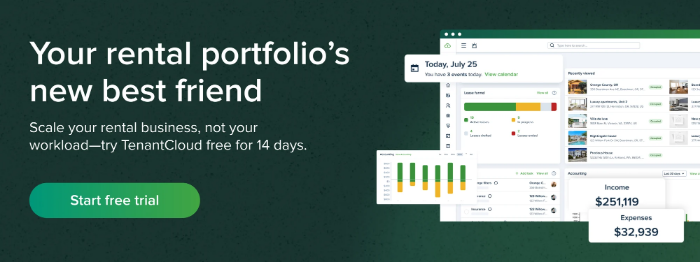
Here are just a few reasons owners and property managers are drawn to TenantCloud:
- All the features, one system. Market rentals, process rental applications, run tenant screening, send lease agreements for e-signatures, collect rent online, coordinate maintenance, and handle accounting inside the same software.
- Robust rent collection tools. Tenants can pay with ACH, credit card, or debit card, and even activate autopay. Late fees can be automated according to your rules, protecting cash flow.
- Comprehensive tenant screening services. Background checks, credit reports, and rental history tools help you screen tenants thoroughly and consistently.
- Strong accounting + automatic bank reconciliation. Income and property expenses are tracked per property, and in-app reconciliation highlights discrepancies so you can catch missed entries early.
- Listing syndication and resident portals. Publish listings to multiple sites, then give residents access to portals where they can manage payments, maintenance requests, and documents in a centralized location.
- Mobile apps and modern interface. TenantCloud’s mobile apps and dashboards are built to be intuitive, supporting user-friendly workflows for both new landlords and experienced operators.
Get started with a free 14-day trial to start managing your residential properties like a pro.
FAQ: Residential Property Management Software
Is residential property management software worth it if I only have a few units?
Yes. Even with a small rental portfolio, residential property management software can save time and reduce errors. You still need to track lease agreements, rent payments, maintenance requests, and property expenses. Automating those tasks early makes it easier to add new properties later without rebuilding your entire system.
How does software improve tenant communication?
Software centralizes tenant communication. Instead of scattered emails and texts, residents use portals or mobile apps to ask questions, submit maintenance requests, and receive important updates. Messages are tied to specific units and tickets, so you and your support team can see the full history when responding, which leads to faster, clearer resolutions.
Can I use the same system for residential and a small commercial property?
Many modern platforms support more than one property type. Look for tools that allow you to customize lease templates, billing rules, and reports for each category. That way, you can manage residential property units, a small commercial property, and even community associations from one system while respecting the differences between them.
How does software help me stay organized for taxes?
By tracking income and property expenses inside your property management software, you create a clear audit trail throughout the year. When tax time arrives, you can generate financial reports that show rent collected, operating costs, and other key figures. That makes it easier to document rental real estate income and deductions, and it reduces the chance of missing important records.
What should I look for if I want to grow my portfolio over time?
If growth is your goal, prioritize a property management solution that scales easily. Look for unlimited unit capacity or pricing that doesn’t punish you for expansion, strong accounting tools, robust tenant screening services, and automation features that handle recurring tasks. A single platform that can support you from a few doors to a large portfolio will do more for long-term success.
With an all-in-one platform like TenantCloud, you can bring everything together in one place, simplify your day-to-day work, and focus on growing a healthy, resilient portfolio.


