

TL;DR
Managing rental properties manually is possible, but can lead to missed deadlines and administrative stress. While property management platforms often feel like a "big business" expense, there are several affordable property management software that can help you automate your tasks without breaking your budget.
Look for platforms that centralize communication, rent collection, and maintenance for best results. However, before committing to a low-cost tool, watch for red flags that can erode the platform’s value.
If you own a property and are planning to lease it out, or already have a few leased out, your administrative workload can quickly pile up. While collecting rent, signing leases, and listing properties manually may seem like a great idea, it’s often a recipe for delays and missed deadlines.
You may have dismissed the idea of property management software, seeing it as a costly tool reserved only for large-scale landlords or professional managers. But there's a wide range of affordable property management software that won’t burn a hole in your pocket and can be used for managing even a single property. With free and low-cost entry plans, there is an affordable plan for everyone.
What is Property Management Software and Why is it Useful?
As the name suggests, these digital platforms centralize property and rental management into one dashboard, acting as comprehensive rental property management software systems. The software solution keeps everything organized and automates various aspects of the process, like sending rent and late fee reminders, which makes it much easier to keep track of rental payments.
Many solutions, like TenantCloud, help landlords accept rental payments online and provide real-time tracking features. They also provide accounting features to reduce the compliance burden on the landlords. Having a suite of property management tools makes rental management easier and more efficient.
Features to Look for in Affordable Property Management Software
Property management software can simplify the landlords' lives, but it needs to have the right sort of features.
While it’s important to vet tools based on your specific bottlenecks, you need to dive deeper when looking at affordable options, as they may lack some critical functions.
Evaluating a solution requires looking closely at everything from accounting and communication to rent collection and reporting. Let's take a look at them.
Tenant Screening
When you’re leasing your properties, it's important to find the right tenant to occupy them. After all, you'd need to know if the tenant would be in a position to pay their monthly rent on time every time, which starts with a clear, step-by-step approach to tenant screening to find the perfect tenant.
At the same time, it’s important to conduct a background check to look for criminal cases and understand their financials. The property management software you choose should offer you a background check for renters, along with credit checks without additional fees.
Maintenance Management
Maintenance is a regular occurrence in property management. Whether it's air conditioners or simply painting the walls, you’ll have to track and monitor maintenance requests from your tenants.
The right platform will enable smooth coordination between vendors and tenants to ensure that all maintenance requests are fulfilled in time, including emergency repairs.
Rent Collection and Accounting
Even the most affordable property management software should offer rent collection, along with late fee calculations and reminders. It's also helpful to have access to 1099-S forms, Schedule E forms, and more reports for tax season. Many affordable platforms charge additional fees for these, so know the fees before you choose a platform.
Artificial Intelligence
Integrating generative AI tools directly into your property management software offers significant advantages. These tools help you move beyond basic automation by writing property descriptions and streamlining workflows like tenant communication and maintenance scheduling. Ultimately, they lead to smoother, more efficient property management.
Landlord-Tenant Communication
Connecting with tenants can take a lot of time. Throw in-person visits into the mix, and the duration increases significantly. Built-in messaging features can help reduce late night calls and texts by centralizing communications into one place.
Red Flags to Watch Out For
When you set out to evaluate affordable property management software platforms, it’s easy to get swayed by their attractive price tag. Before committing to a solution, make sure you watch for these red or yellow flags:
Hidden Costs
To show affordability or “free” pricing, a platform could hide its costs. These could be in the form of:
- Paid add-ons like rent collection features
- Additional charges for inactive units
- High setup pricing
- Hidden recurring costs like ACH fees
Read the fine print on the pricing page to determine whether the platform is truly as affordable as it claims or if it has hidden charges.
Functionality Issues
Before opting for a paid plan, try testing the tool with a free trial. It’ll help you uncover potential usability issues, such as a lack of integrations or poor automation workflows.
Be sure to check if the tool offers a smooth mobile experience through its website or app. Affordability can sometimes come with usability issues, so it’s best to verify before purchasing.
Customer Support Reliability
Check whether the vendor offers live customer support. Several affordable tools tend to rely on passive support features like FAQs rather than investing in prompt responses from agents.
Pro Tip: Some tools may lag behind in updates, making them obsolete and forcing you to switch platforms. The right tool will support your business growth at every stage.
Affordable Property Management Software: A Quick Comparison
Trying to pick the right property management solution can feel overwhelming. To save you the effort of researching each one individually, we've vetted the platforms ourselves and prepared a list of the best for you.
Let's check them out.
1. TenantCloud: Property Management Software with Built-in Payments
TenantCloud is well-known for its affordable property management software. With a range of plans, it's built specifically keeping landlords of all sizes in mind and grows with your portfolio.
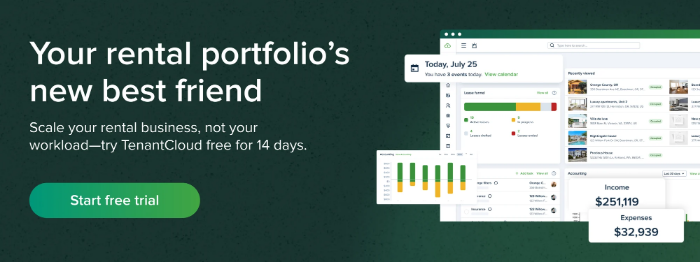
The basic plan starts at just $16.5/month and provides unlimited units, so costs are low and predictable. From finding trustworthy tenants to managing multiple properties and accounts, the platform handles the entire property management life cycle, helping you save time and streamline tasks without overspending.
Features:
- Rent and late fee reminders, with online rent collection and invoicing
- Robust tenant screening with background and credit checks
- Online lease agreement templates and ready-to-go forms
- Maintenance request management
- AI assistant for drafting property listing copy
- Lead management tools and communication tracking
- Accounting and automatic bank reconciliation features
Pros:
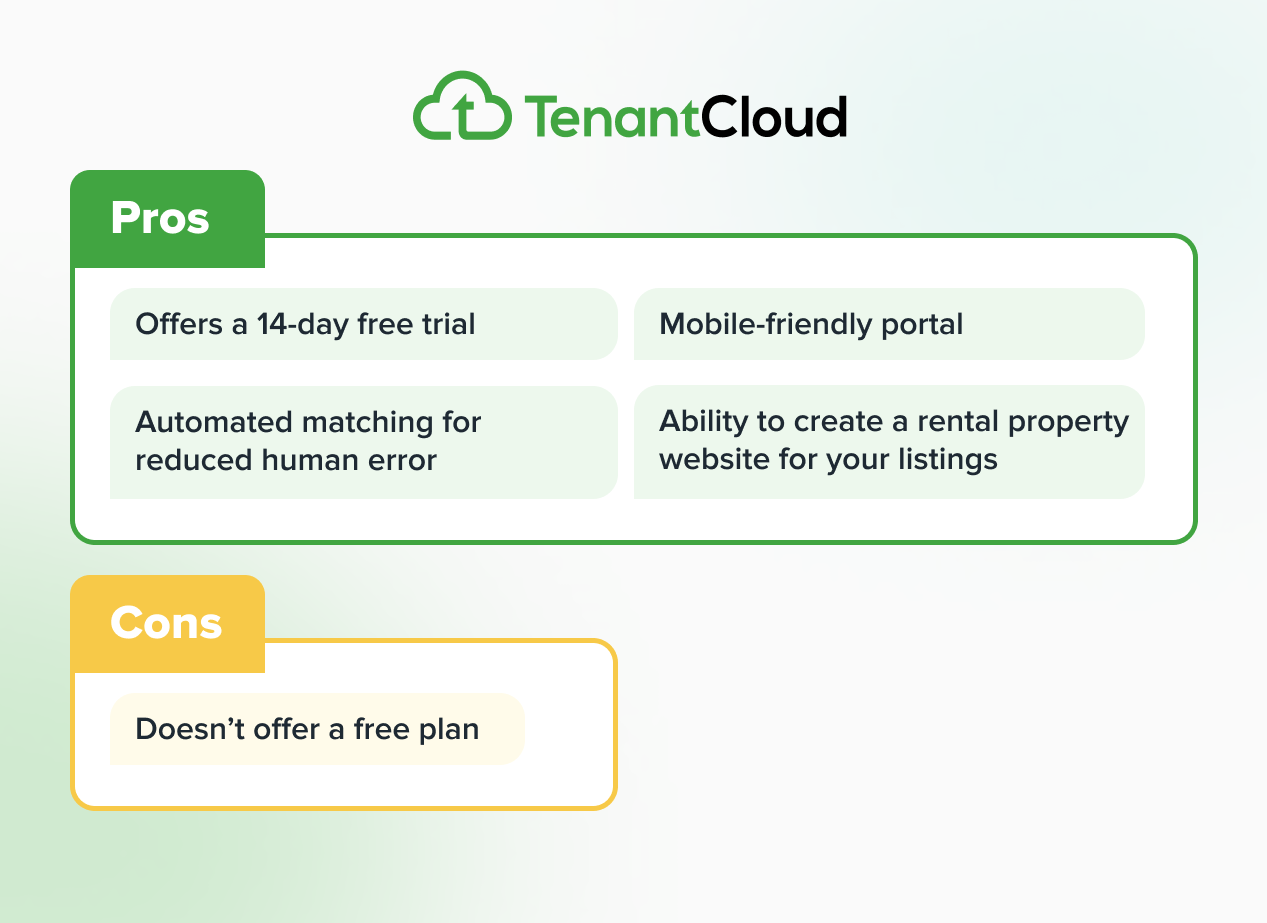
- Offers a 14-day free trial
- Mobile-friendly portal
- Automated matching for reduced human error
- Ability to create a rental property website for your listings
Cons:
- Doesn’t offer a free plan
Pricing: TenantCloud’s paid plans start at just $16.50/month, and even on the higher end, the Pro plan costs $50/month. This makes it a great option for landlords managing a variety of properties with limited budgets.
2. DoorLoop: Collect Rent Online with Ease
DoorLoop is an easy-to-use property management platform that lets you collect rent on autopilot with its reminders and autopay features. The platform integrates with Stripe for payments.
It also offers a CRM, financial reports, and tenant screening features to make things easier for owners.
While its paid plans cost slightly more, you can handle up to 10 units in its base plan, making it well worth the price tag and features. They also offer free onboarding on some plans.
Features:
- Full accounting suite with bank sync and QuickBooks integration
- Tenant screening for credit, criminal, and eviction history
- Automated listing syndication
- Maintenance management with dedicated vendor portals
- AI-powered rental property inspection using images
- Owner portals with on-demand financial reporting
- Mobile app for managing properties and documents
Pros:
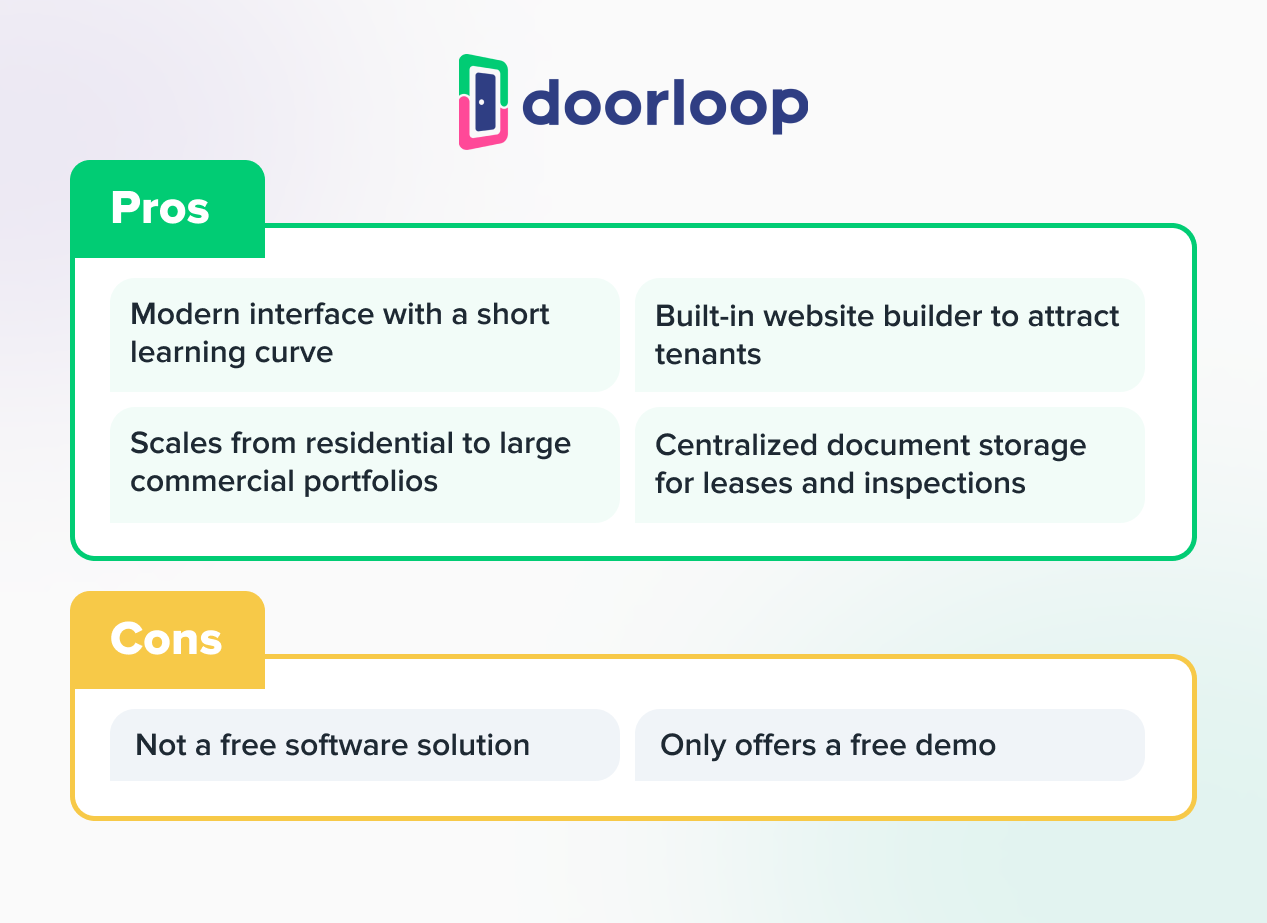
- Modern interface with a short learning curve
- Scales from residential to large commercial portfolios
- Built-in website builder to attract tenants
- Centralized document storage for leases and inspections
Cons:
- Not a free software solution
- Only offers a free demo
Pricing: Base plan costs $69/month, so this is a decent option for medium to large portfolios.
3. Buildium: Advanced Maintenance Management for Large Portfolios
One key benefit of using Buildium is maintenance management. It provides a dedicated contact center that answers your tenants’ queries and logs maintenance requests on your behalf.
Along with maintenance management, Buildium offers several other features like accounting, lease signing, and listing drafting.
Its base plan isn’t the cheapest, but it lets you manage up to 150 units, making it an affordable option if you’ve got numerous properties. You also get slightly lower ACH fees than other tools.
Features:
- Property accounting with automated bank reconciliation
- Online leasing tools, including e-signatures and lease templates
- Resident and owner portals for payments and financial reporting
- AI agents for maintenance, leasing, accounting, and more
- Tenant screening for credit, criminal, and eviction history
- Automated 1099-S e-filing for tax compliance
Pros:
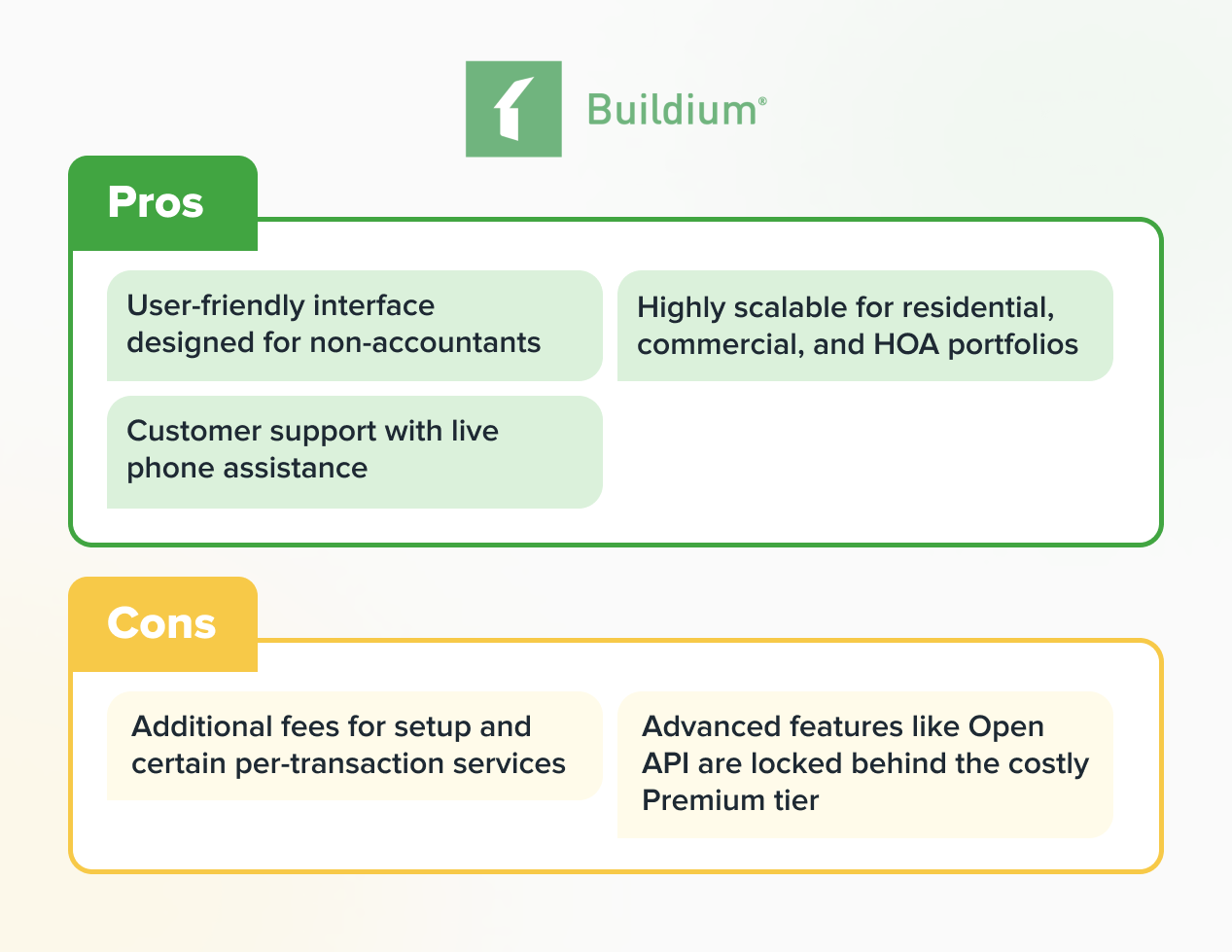
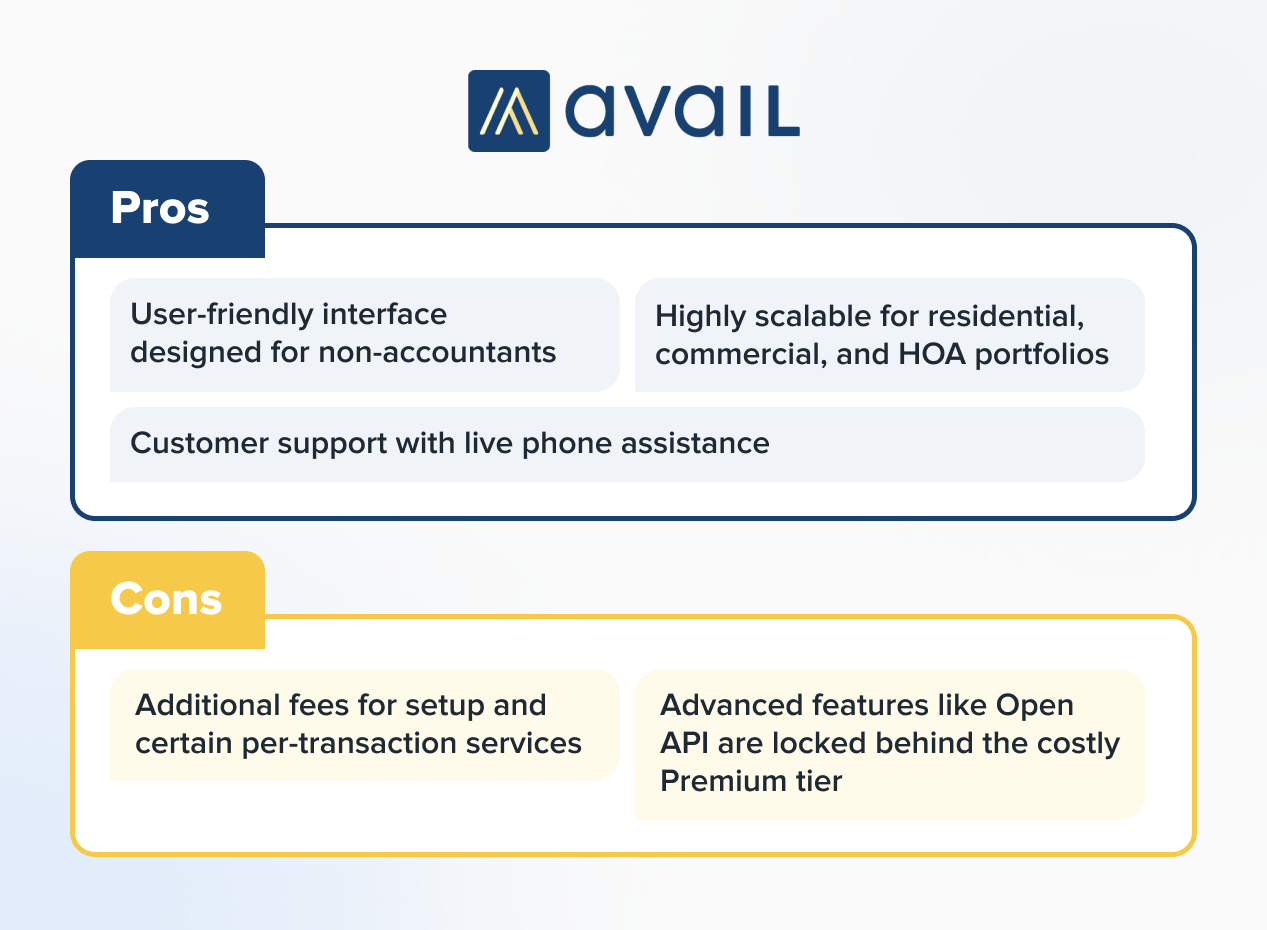
- User-friendly interface designed for non-accountants
- Highly scalable for residential, commercial, and HOA portfolios
- Customer support with live phone assistance
Cons:
- Additional fees for setup and certain per-transaction services
- Advanced features like Open API are locked behind the costly Premium tier
Pricing: Base plan starts at $62/month for up to 20 properties, so a portfolio with 150 properties sits around $288/month. This is another option for larger portfolios looking for full support at an affordable price.
4. Innago: The Best Free Property Management Software for DIY Landlords
Innago is a free property management software, making it a great option if you’re on a tight budget. However, you have to make some trade-offs, as certain features aren’t as extensive as those in other tools.
That said, it does offer some handy options like accepting online rent payment, expenses and reporting, mobile app, tenant screening, and online lease signing. You only pay to screen tenants and accept rental payments online.
Features:
- Tenant screening, including credit, criminal, and eviction history
- Digital lease signing with customizable templates and storage
- Maintenance ticket management with photo and video attachments
- Automated late fee calculation and payment reminders
- Financial tracking with QuickBooks integration and tax reporting
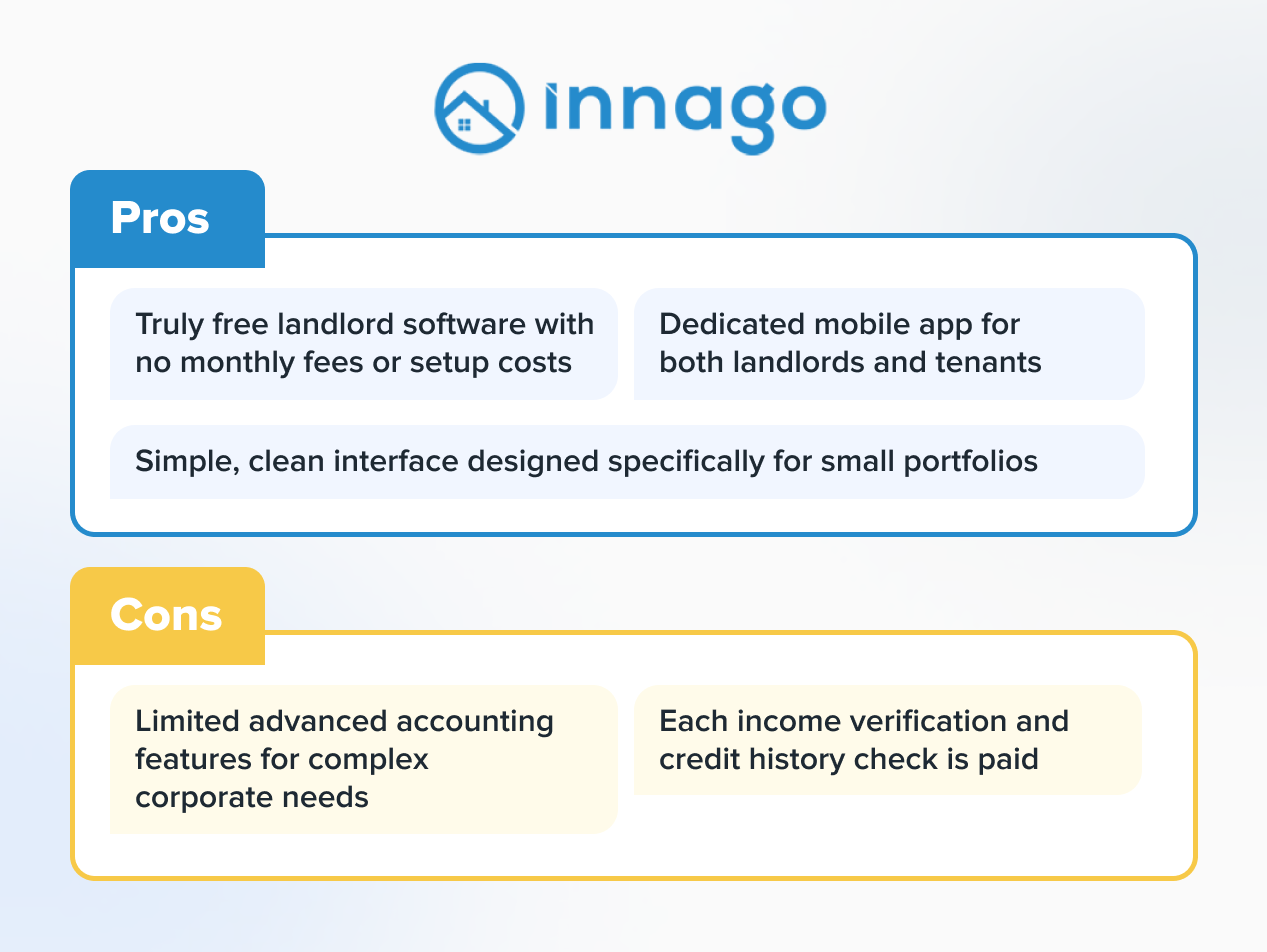
Pros:
- Truly free landlord software with no monthly fees or setup costs
- Dedicated mobile app for both landlords and tenants
- Simple, clean interface designed specifically for small portfolios
Cons:
- Each income verification and credit history check is paid
- Limited advanced accounting features for complex corporate needs
Pricing: Free, but higher ACH fees of $2 and 2.99% for debit payments. Background checks cost $30-35 per check as well.
5. TurboTenant: Document Management Simplified for Landlords
TurboTenant is another free property management platform with paid tiers.
The platform offers several features like an AI description generator, listing syndication, and tenant screening. You can also collect rent online and set custom late fees for it.
What makes this platform so affordable is that all its plans are priced reasonably, and the Pro plan even comes with free ACH payments, a plus for many property managers. While the free plan is limited, it supports unlimited property listings.
Features:
- Online rental applications with automated reference checks
- Lease agreement builder with state-specific legal templates
- Maintenance request tracking with in-app messaging
- Online condition reports with photos
- AI lease audit for compliance
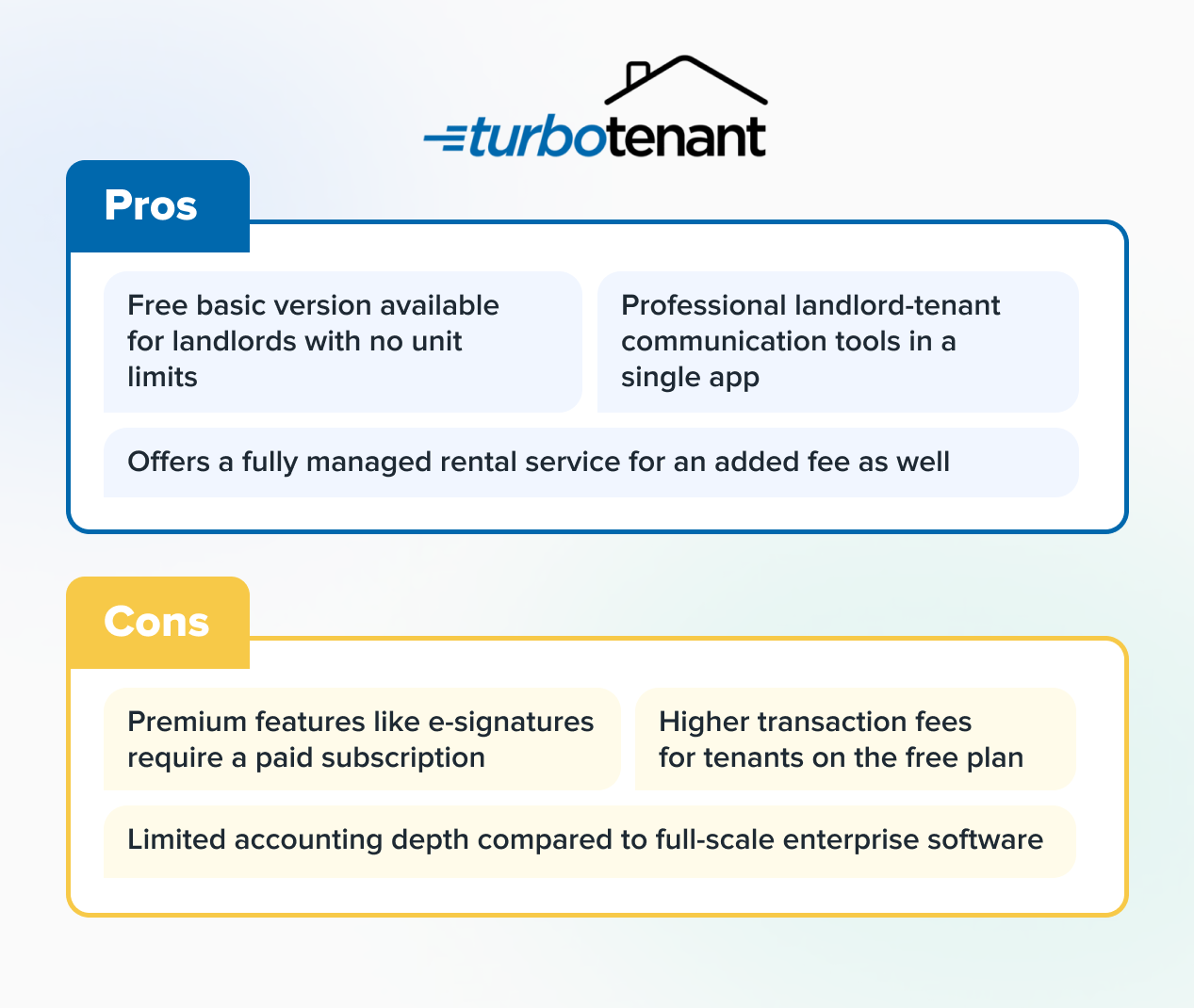
Pros:
- Free basic version available for landlords with no unit limits
- Professional landlord-tenant communication tools in a single app
- Offers a fully managed rental service for an added fee as well
Cons:
- Premium features like e-signatures require a paid subscription
- Higher transaction fees for tenants on the free plan
- Limited accounting depth compared to full-scale enterprise software
Pricing: Free basic plan with the highest tier plan starting at $16.58/month. Some plans contain additional ACH fees and form fees.
6. Avail: Lawyer-Reviewed Lease Agreements
Avail is an affordable property management software that offers standard features such as tenant screening, maintenance tracking, and online rent collection. But what stands out are its state-specific, lawyer-reviewed lease agreement templates, ensuring you always comply with local laws.
It offers a free plan with several basic property management tools for unlimited properties. However, tenants have to pay $2.50/bank transfer if they’re on the free plan.
Features:
- Syndicated listings to over 24 top rental sites like Realtor.com and Zumper
- Online rent collection with automated reminders and receipts
- Maintenance request tracking with photo and in-app messaging
- Rent price analysis and rental property calculator
- FastPay option for next-day rent deposits to landlord accounts
- Property accounting features for tax compliance
Pros:
- Free "Unlimited" plan available for basic management needs
- Part of the Realtor.com network for high-visibility listing exposure
- Clean, easy-to-use interface for independent landlords
Cons:
- Lacks a dedicated mobile app for landlords and tenants
- Per-unit pricing means costs can rise quickly
Pricing: Free plans. A monthly fee ($9 per unit) is required for next-day payments and custom leases with a 3.5% processing fee for card payments.
Related: TenantCloud vs Avail: What Landlords Need to Know and TenantCloud vs TurboTenant
7. Hemlane: AI-Powered Property Management
Hemlane is a property management platform that simplifies accounting and lease management, offering state-specific lease agreements and eSign capabilities.
It’s particularly affordable for rent collection, with $0 ACH fees, and even lets you offer perks to tenants through renter rewards and protection.
The software also allows property managers to perform credit, background, and eviction checks, and uniquely offers pre-screening and showing scheduling for tenants.
The platform’s free plan is particularly helpful for landlords with a smaller property portfolio, but it lacks online payments.
Features:
- Listing syndication to over 15+ rental websites
- Maintenance coordination with 24/7 support options
- Financial tracking with bank sync and Schedule E reporting
- Optional "boots-on-the-ground" support for showings and inspections
- Automated late fee enforcement and tenant payment reminders
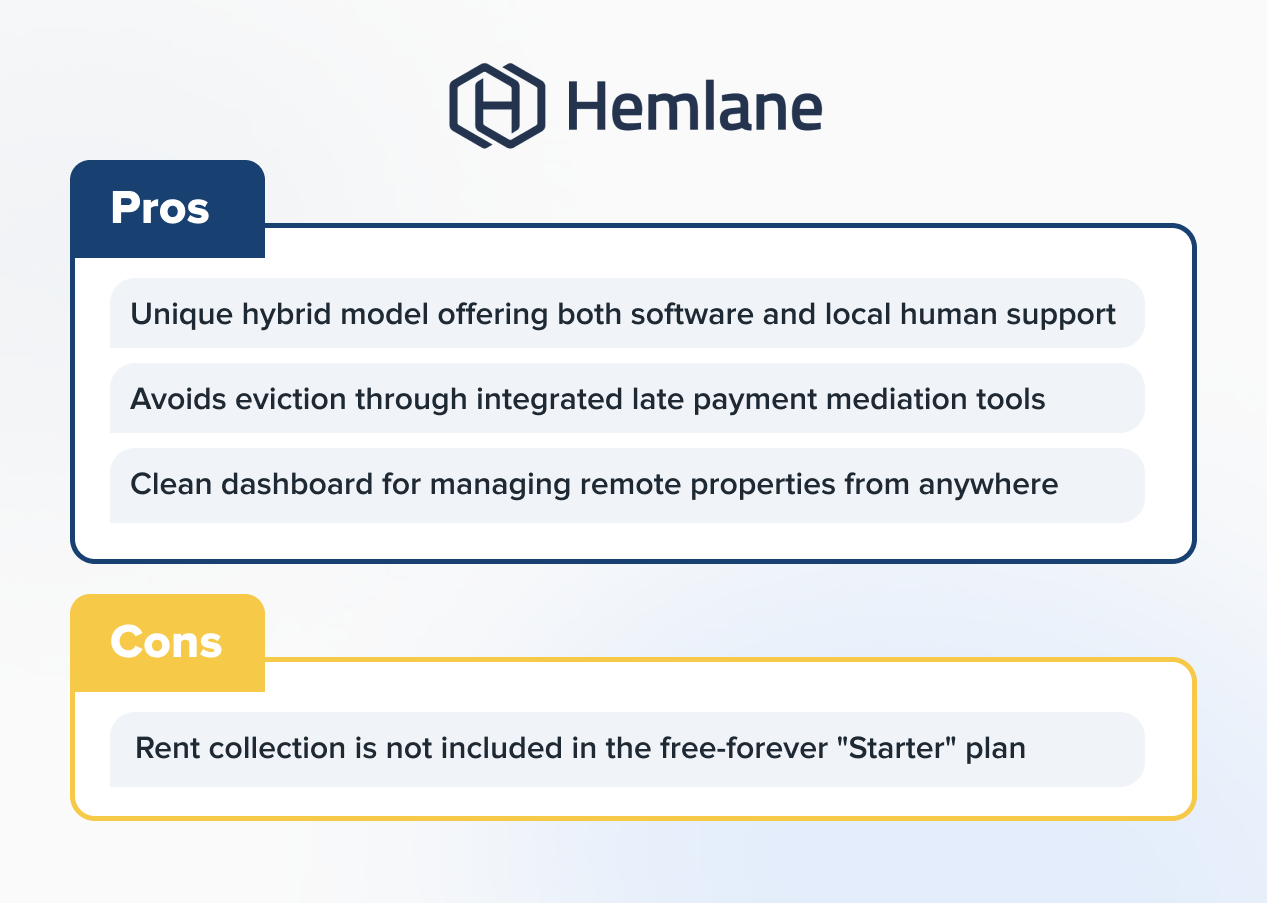
Pros:
- Unique hybrid model offering both software and local human support
- Avoids eviction through integrated late payment mediation tools
- Clean dashboard for managing remote properties from anywhere
Cons:
- Rent collection is not included in the free-forever "Starter" plan
Pricing: Free intro plan. Base paid plan at $28/month with $2/unit additional pricing.
8. Landlord Studio: Property Management with GPS Mileage Tracking
Landlord Studio is a property management solution designed for DIY landlords seeking streamlined financial tracking. It simplifies the rental process with automated rent collection, bank-reconciled accounting, and built-in receipt scanning.
Ideal for managing on the go, it provides professional-grade reporting and tenant screening to keep your portfolio organized and profitable.
The platform offers a free-forever plan for up to 3 units. And while it offers many basic features, support options are limited. As you scale, you’ll have to switch to paid plans, but these are reasonably priced, too, and offer better features.
Features:
- Built-in accounting with bank feed integration and receipt scanning
- Professional financial reports, including Schedule E and profit/loss
- GPS mileage tracker for logging property-related travel
- Tenant screening for credit, criminal, and eviction history
Pros:
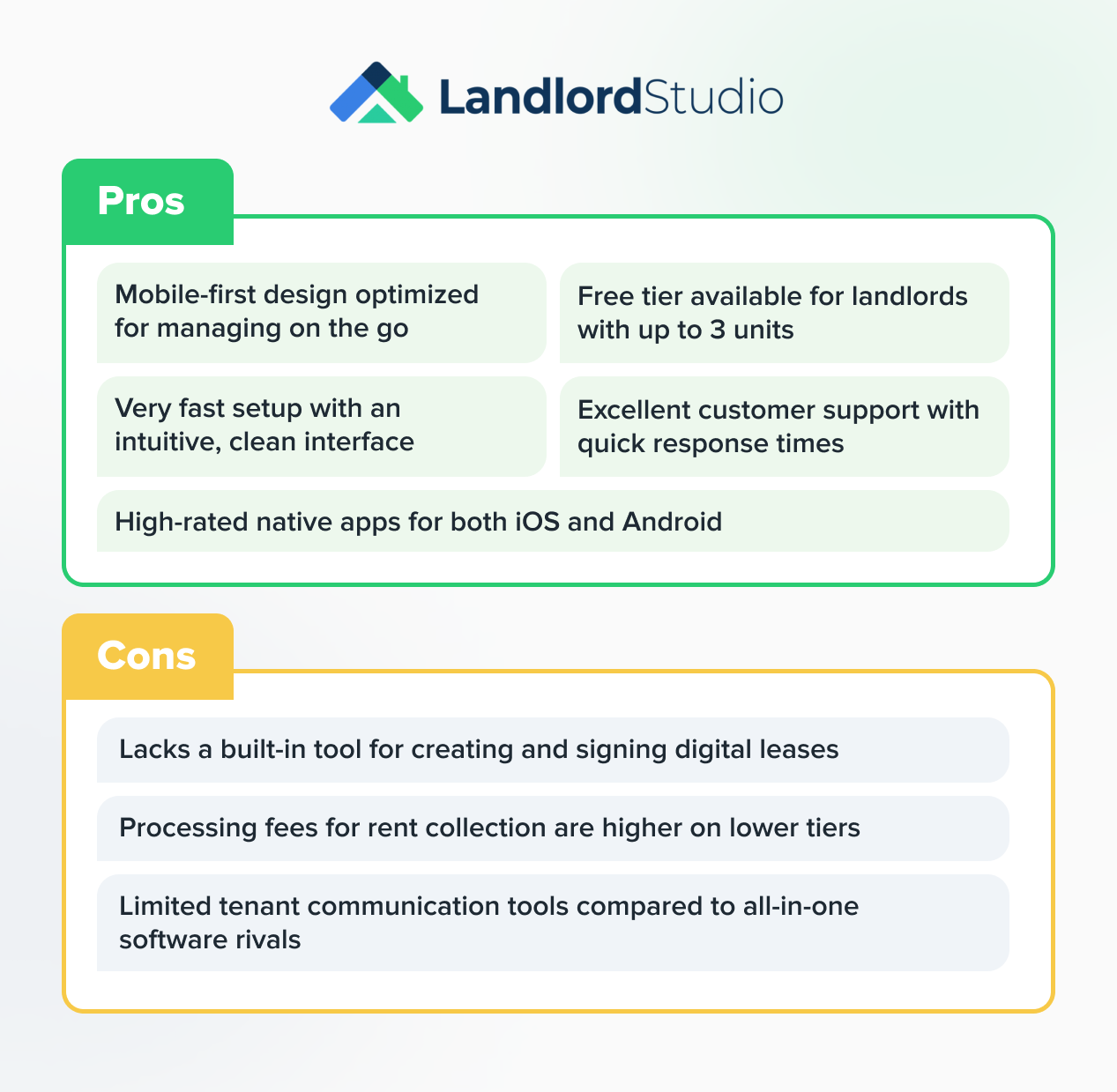
- Mobile-first design optimized for managing on the go
- Free tier available for landlords with up to 3 units
- Very fast setup with an intuitive, clean interface
- Excellent customer support with quick response times
- High-rated native apps for both iOS and Android
Cons:
- Lacks a built-in tool for creating and signing digital leases
- Processing fees for rent collection are higher on lower tiers
- Limited tenant communication tools compared to all-in-one software rivals
Pricing: Paid plans start at $12/month for 3 units, with each additional unit costing $1. Even at scale, this makes its pricing affordable.
9. Stessa: Affordable Property Lifecycle Management
Stessa helps with tenancy and rent collection just like other property management software. But it stands out as it serves the entire property life cycle, from purchase to sale. You can find investment properties, lease them, and then sell them right from within the platform.
The platform offers a free pricing tier with unlimited properties, making it a great fit for those on a low budget. And if that’s not enough, you also get 1.88% APY for cash balances. That said, the features in the free plan are slightly limited, with no eSignatures and templates.
Features:
- Automated income and expense tracking via linked bank and mortgage accounts
- Real-time financial dashboards for cash flow, NOI, and asset appreciation
- Dedicated landlord banking with high-yield interest on cash balances
- Tax-ready financial reports, including Schedule E and net cash flow statements
Pros:
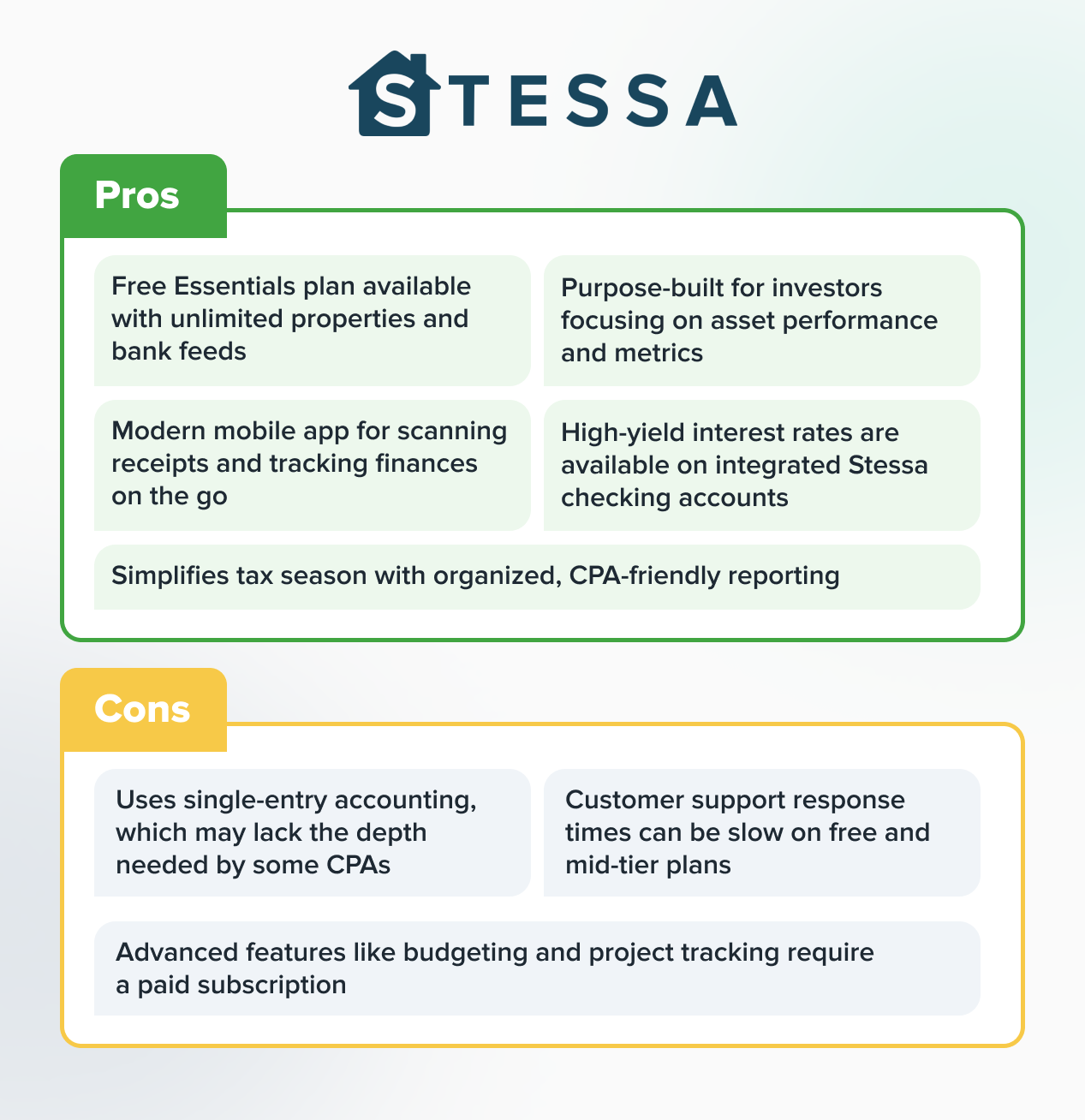
- Free Essentials plan available with unlimited properties and bank feeds
- Purpose-built for investors focusing on asset performance and metrics
- Modern mobile app for scanning receipts and tracking finances on the go
- High-yield interest rates are available on integrated Stessa checking accounts
- Simplifies tax season with organized, CPA-friendly reporting
Cons:
- Uses single-entry accounting, which may lack the depth needed by some CPAs
- Customer support response times can be slow on free and mid-tier plans
- Advanced features like budgeting and project tracking require a paid subscription
Pricing: Paid plans start at $12/month for unlimited properties. However, there’s a limit on the number of monthly eSigns and contracts, even on paid plans.
Future-Proofing Your Real Estate Business
Whether you’re leasing a single property or several, it’s essential to manage them effectively for better returns on your investment. With affordable property management software, you can get more done with less time. The key is to find a solution that can handle all your rental needs, grow with you, and support your tenants.
TenantCloud offers three affordable plans to fit every portfolio size—from small and DIY landlords to large-scale rental businesses. Try our 14-day free trial now to start collecting rent, managing leases, screening tenants, and listing properties with ease.
Affordable Property Management Software FAQs
What is the most affordable property management software?
Platforms like TenantCloud, Innago, and TurboTenant are often ranked among the most affordable, thanks to their free or basic tier plans. While each software varies on what it offers, all are reliable and highly recommended by landlords.
Is it worth using property management software for just one or two units?
Yes. Even for a single rental, manual tracking is a recipe for missed late fees or lost receipts. Using a modern platform centralizes your income and expense tracking, making tax season significantly less stressful for independent landlords.
How do affordable property management platforms simplify the tenant screening process?
Most property management systems allow you to streamline the entire application and screening process. From customizing rental applications to generating tenant screening reports, these platforms help you verify potential applicants in one easy workflow.
What is the difference between a free plan and a premium landlord software subscription?
There are different types of affordable property management software: free and low-tier subscriptions. A free plan typically covers the basics, such as listing your property and collecting rent. Pro or premium plans usually offer more value for the money, with advanced features like automated bank reconciliation, e-signatures for lease management, and more robust reporting tools for your portfolio.
Can I manage maintenance and communication in one place with affordable property management software?
Yes. Many all-in-one software includes maintenance and communication tools at affordable rates. Software solutions like TenantCloud offer separate tenant portals, built-in communication, and maintenance request boards where tenants can submit photos and make repair requests. This centralizes all communication and management tasks, providing a clear audit trail for both you and tenants.


