
TL;DR
- License required: Managing Texas rentals for others for compensation requires a TREC-issued real estate license.
- Two paths: A sales agent license, sponsored by a broker, or a full broker's license.
- Education: Texas requires 180 hours of qualifying pre-licensing coursework — six 30-hour courses.
- Exam: A two-section Pearson VUE exam, national and state, scored separately at 70% each.
- Cost: Budget roughly $700 to $1,300 total for coursework, $206 for the application, $43 for the exam, and fingerprinting.
- Timeline: You can obtain an active license within 3 to 6 months.
- Exemptions: Owners managing their own property or certain on-site managers.
Moving into property management from sales, leasing, or maintenance can feel like a natural next step. That there are licensing requirements in Texas specifically for property managers who handle rentals for pay. Tasks like collecting rent, signing leases, and advertising vacancies all count as regulated real estate work under the rules for a property management license in Texas.
Skipping the license process can trigger enforcement action from the Texas Real Estate Commission, financial penalties, and unpaid management fees that a court will not help recover. This guide explains how to become a property manager in Texas, including the qualifications, application steps, total cost, and how property management software can help.

Duties of a Property Manager
A Texas property manager runs the full operation for owners, often across dozens of units at once, and the daily duties include:
- Marketing property to fill vacancies fast and keep turnover down
- Collecting rent and managing owner disbursements on a predictable monthly cycle
- Drafting, executing, and enforcing lease agreements for tenants
- Coordinating and logging maintenance requests and paying vendors
- Screening tenants and managing vacancies ahead of each move-in
- Handling tenant communication on notices, disputes, and renewals
- Trust accounting and owner financial reporting on a set schedule
- Conducting inspections at move-in, move-out, and mid-lease
- Ensuring fair housing compliance across every listing and application
The right software for property managers can help centralize these tasks so you don’t need to juggle spreadsheets, collect rent in person, or sort through piles of paper applications.
Does Texas require a property management license?
Yes. Texas treats managing rental property for others for compensation as brokerage activity under the Texas Real Estate License Act, so a manager must hold a real estate license or work under one (Tex. Occ. Code § 1101.002).
The license authorizes a manager to handle paid tasks for an owner: collecting rent, executing lease agreements, negotiating terms, and advertising vacancies. Each act carries legal and financial obligations to landlords and tenants, which is why the state regulates who may perform them.
Note: A third-party manager paid to run someone else’s rentals needs a license, but an owner managing personal rentals does not. The Texas Real Estate Commission (TREC) administers and enforces these requirements.
Texas Property Manager License Requirements
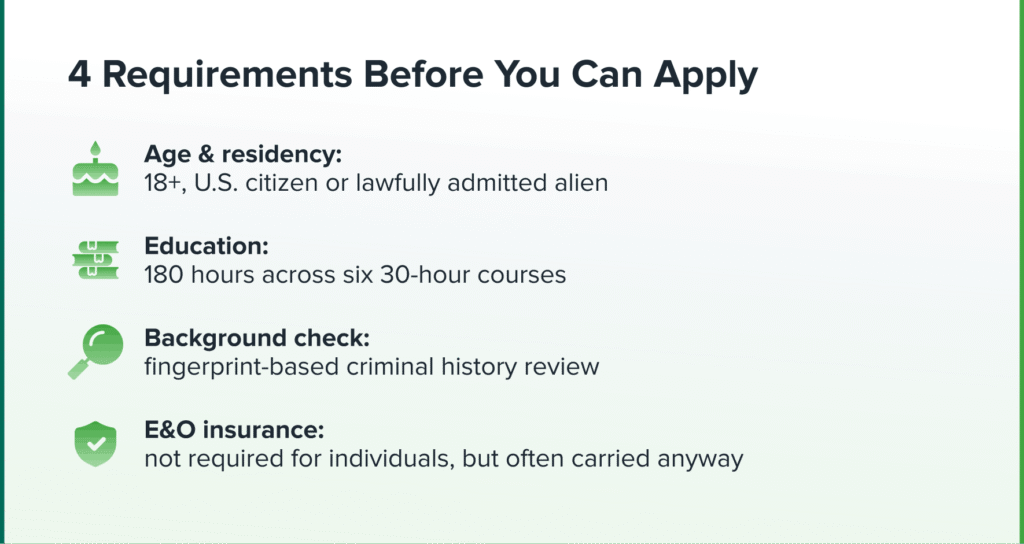
Property manager qualifications in Texas begin with the sales agent license, the entry credential for most people managing under a sponsoring broker. A broker’s license permits independent operation but requires four years of qualifying experience and far more coursework (900 hours, compared to the sales agent’s 180). Both paths can start after you meet the state’s baseline standards:
Age and Residency
You must be at least 18 years old, a U.S. citizen or lawfully admitted alien, and meet TREC’s standards for honesty, trustworthiness, and integrity (Tex. Occ. Code § 1101.354).
Texas also licenses nonresidents who meet the same requirements and file a consent to service of process.
Pre-Licensing Education
Texas property manager education requirements run higher than in most states: 180 hours of qualifying coursework across six 30-hour courses. The six cover Principles of Real Estate I and II, Law of Agency, Law of Contracts, Promulgated Contract Forms, and Real Estate Finance. You must finish the hours through a TREC-approved provider before applying.
Background Check
Texas requires a fingerprint-based criminal history review. You’ll need to submit fingerprints through IdentoGO for a check routed to the Texas Department of Public Safety and the FBI. TREC will then weigh that history against its honesty, trustworthiness, and integrity standards, and a conviction tied to the occupation’s duties may affect your eligibility (Tex. Occ. Code § 53.021).
Errors and Omissions Insurance
Texas does not require errors and omissions insurance for an individual sales agent or broker license. Many property managers still carry E&O anyway, since it shields personal and business assets when a client alleges a mistake.
Business entities face a separate rule: E&O coverage of at least $1 million per occurrence is mandatory if the designated broker owns less than 10% of the entity (Tex. Occ. Code § 1101.355).
How to Get Your Texas Property Management License
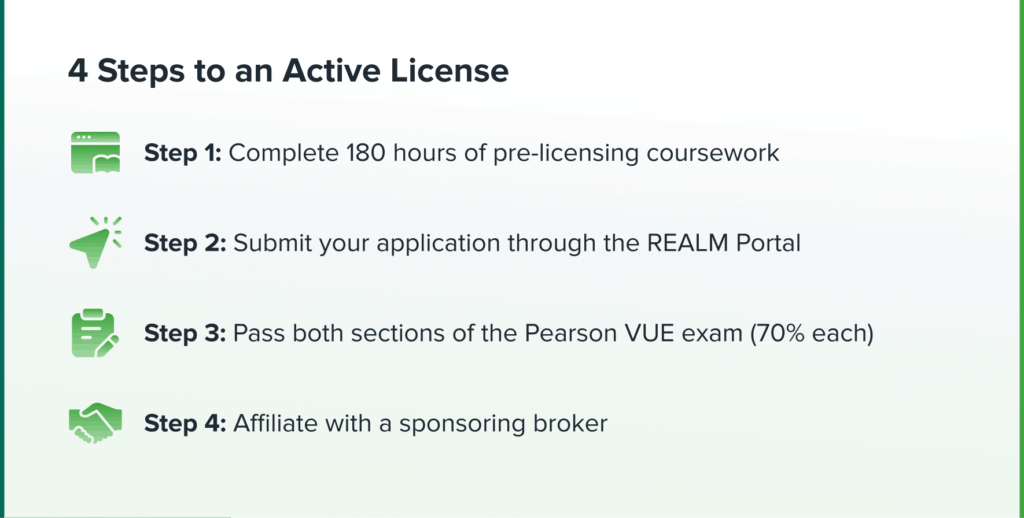
The steps to become a property manager in Texas follow a linear path, and knowing the order prevents wasted time and repeated fees. The route below tracks the sales agent license, the credential most new managers earn first:
Step 1: Complete Your Pre-Licensing Coursework
Enroll with a TREC-approved school and complete the 180 required hours, available fully online or in a classroom. Coursework is the largest single expense, running roughly $400 to $1,000 depending on the provider. You must finish these hours before your application can move forward.
Step 2: Submit Your License Application
Next, you’ll need to apply through the REALM Portal by following TREC’s sales agent instructions, pay the $206 application fee, and submit your fingerprints for the background check. TREC does not issue a license at this stage. Once TREC approves your application, it will send exam eligibility to Pearson VUE so you can schedule the test.
Step 3: Pass the Texas Real Estate Exam
Pearson VUE will administer the licensing exam at testing centers across the state once your eligibility is posted. The exam is split into an 85-question national section and a 40-question state section. Each section is scored separately, and each requires 70% to pass.
The fee is $43 per attempt. After three failed attempts on a section, you must complete an additional 30 hours of qualifying education for that section before retesting.
Once you pass both sections and TREC clears your background check, the Commission will issue your license, though it stays inactive until a sponsoring broker activates it.
Step 4: Affiliate with an Employing Broker
A Texas sales agent cannot practice under an inactive license. You submit a sponsorship request through the TREC portal, and your license will go live once an active Texas broker accepts it.
The sponsoring broker will be legally accountable for your work and must supervise the property management you handle. Operating independently without a sponsor requires earning a broker’s license.
Costs and Timeline
Expect to spend $700 to $1,300 for a Texas sales agent license.
The pre-licensing course accounts for most of that cost, since provider pricing varies by format and bundled exam prep. The application and testing fees stay fixed. Because Texas sets no E&O requirement for individuals, the total also runs lower than in many states.
- Pre-licensing course (180 hours): $400 to $1,000
- State exam fee: $43 per attempt
- Application fee: $206
- Fingerprinting: $37
- E&O insurance: Optional, not required in Texas
Most candidates reach an active license in 3 to 6 months. The 180 required hours set the pace, and TREC’s review adds more time. Check the Commission’s posted processing dates before you book the exam or line up a sponsoring broker.
Who is exempt from Texas's license requirement?
A few exemptions sit outside the Texas license requirement:
Owners managing their own property: An owner who manages personal rentals does not need a license, since the requirement applies only to managing for others.
On-site apartment managers and owner employees: State law exempts an on-site manager of an apartment complex and an owner’s employee who leases only that owner’s real estate (Tex. Occ. Code § 1101.005(7), (8)).
That apartment exemption applies only to on-site managers, not to other property types or owners’ portfolios. Managing through an LLC may complicate the owner exemption, and neither provision covers a company collecting management fees for others.
What happens if you manage property without a license in Texas?
Managing property for others without a license carries legal exposure on several fronts, and the state has more than one enforcement tool:
Court injunction: TREC can seek a court injunction to stop the unlicensed activity (Tex. Occ. Code § 1101.751).
Cease-and-desist authority: After notice and a hearing, the Commission may issue a cease-and-desist order against the unlicensed operator (Tex. Occ. Code § 1101.759).
Administrative penalties: TREC can impose an administrative penalty of up to $5,000 for each violation, and each day a violation continues may count as a separate violation (Tex. Occ. Code § 1101.702).
Criminal exposure: Acting as a broker or sales agent without a license is a Class A misdemeanor (Tex. Occ. Code § 1101.758).
Unenforceable contracts: Unpaid management fees may be uncollectible in court, since an unlicensed person cannot maintain an action to recover compensation for acts performed as a broker or sales agent (Tex. Occ. Code § 1101.806).
Business risk: Owners rarely keep a manager who operated outside the law, and word of it often follows the property manager to the next account.
Beyond the License: Starting Your Texas Property Management Career
Getting licensed is the first step, but a profitable operation takes more than a credential. The daily work involves collecting rent on time, turning around maintenance requests, keeping owner statements up to date, and handling lease renewals across all units.
TenantCloud’s property management software consolidates those tasks into one system, rather than personal notes and email threads. As the portfolio grows, team management grants leasing agents, maintenance techs, and accountants access only to the records their roles require.
And because accurate books hold up every owner relationship, integrated accounting with built-in bank reconciliation keeps records clean and audit-ready for each owner statement.
Start a free 14-day trial with TenantCloud and manage your first Texas property with confidence.
Frequently Asked Questions
Do you need a real estate license to be a property manager in Texas?
Yes, Texas requires a real estate license, either a sales agent license under a sponsoring broker or a broker’s license, to manage property for others for compensation. The rule comes from the Texas Real Estate License Act, though managing property you own personally stays exempt.
How long does it take to get a property management license in Texas?
Most candidates move from coursework to an active license in 3 to 6 months. The 180 hours of education set the pace, followed by TREC’s application review, exam scheduling, fingerprinting, and securing a sponsoring broker.
How much does a Texas property management license cost?
The full path commonly runs $700 to $1,300, with the pre-licensing course as the main variable. Add the $206 application fee, the $43 exam fee, and the $37 fingerprinting fee. Texas requires no E&O insurance for an individual license, which keeps the total down.
Can I manage a rental property in Texas without a license?
Only property you own personally. Managing rentals for others without a license exposes you to TREC enforcement, cease-and-desist orders, and administrative penalties. It also leaves you unable to sue for the compensation earned. Acting as an unlicensed broker or sales agent is also a criminal offense under state law.
What's the difference between a real estate salesperson license and a broker's license in Texas?
A sales agent license permits property management activities only under a sponsoring broker, who supervises the work and holds legal responsibility for it.
A broker’s license permits independent operation, but it requires four years of active experience during the preceding five years, totaling 720 experience points, plus 900 hours of education: 270 qualifying hours and 630 related hours, subject to permitted substitutions.
For property management, a sponsored sales agent license is enough, and full broker status is not mandatory.