TL;DR
- License required: New York classifies paid rental management as brokerage, so having a broker's license or working under a sponsored broker is mandatory.
- Governing body: Issued by the New York Department of State, Division of Licensing Services.
- Entry path: Salesperson license, which leads to management work under a sponsoring broker.
- Education: 77 hours of coursework for a salesperson; 152 hours plus qualifying experience for brokers.
- Cost: Roughly $259 to $580 covers coursework, $15 exam, and $65 application fee.
- Self-management stays exempt: Owners managing their own property don't need a license.
- Penalty for skipping: Unlicensed practice is a misdemeanor; cannot sue to collect fees.
Property managers handle nearly everything a landlord would otherwise do themselves: marketing vacancies, collecting rent, drafting leases, and coordinating repairs. However, collecting rent for compensation requires compliance with the state’s brokerage rules. The property management license New York requires is not optional for anyone operating for compensation.
Keep in mind that skipping this licensing comes with several risks, including enforcement by the Department of State, a misdemeanor charge, and no ability to sue for unpaid management fees. This guide covers how to become a property manager in New York, the coursework and fees, what a compliant operation looks like, and how property management software can help.
Duties of a Property Manager
Property management in New York carries legal and financial exposure, which is why the state ties several core duties to a license, including:
- Marketing property and filling vacancies within fair housing limits
- Collecting rent and managing owner disbursements (handling other people’s money)
- Drafting, executing, and enforcing lease agreements, including renewals
- Coordinating and logging maintenance requests, then paying vendors
- Screening tenants and managing vacancies to keep units filled with qualified renters
- Handling tenant communication, from notices to move-in and move-out
- Trust accounting and owner financial reporting to keep numbers airtight
- Conducting inspections at move-in, move-out, and periodic intervals
- Ensuring fair housing compliance and following local landlord-tenant rules
Finding the right software for property managers can help centralize tasks so you don’t need to juggle spreadsheets or sort through dozens of emails and paper applications.
Does New York require a property management license?
Yes. New York treats managing rental property for others for compensation as a real estate activity, triggering a broker’s license requirement. The broker definition reaches anyone who collects or attempts to collect rent on another’s behalf (N.Y. Real Prop. Law § 440).
The license authorizes the property manager to collect rent, execute lease agreements, negotiate lease terms, and advertise vacancies. A companion provision makes the license mandatory before anyone performs that work (N.Y. Real Prop. Law § 440-a).
Third-party managers paid to run someone else’s property must hold a license, while owners managing their own rentals do not. The New York Department of State, Division of Licensing Services, oversees the requirement.
New York Property Manager License Requirements
Property manager qualifications in New York are governed by the state’s real estate licensing rules rather than a separate statute. They apply before the steps below and cover three areas:
Age and Residency
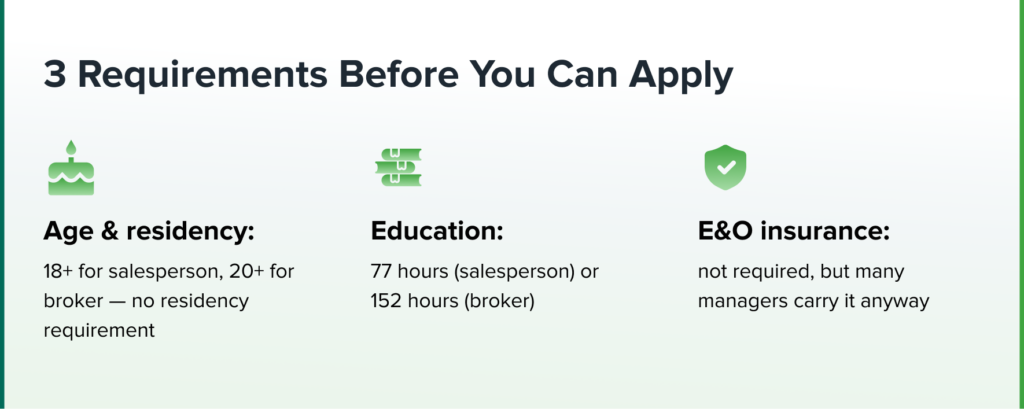
New York sets the minimum age for a salesperson license at 18 and for a broker license at 20. There is no residency requirement, though out-of-state applicants must still attend the exam in person in New York.
Pre-Licensing Education
Property manager education requirements begin with approved qualifying coursework. A salesperson license requires 77 hours of instruction from a Department of State-approved school. The broker license takes 152 hours in total, combining the salesperson course with additional broker instruction.
Errors and Omissions Insurance
New York does not mandate errors and omissions coverage, unlike several other states. Many managers carry it anyway, since a single claim for a mishandled deposit or a lease error can exceed a year’s worth of premiums.
How to Get Your New York Property Management License
Learning how to become a property manager in New York means completing coursework, passing the state exam, and pairing with a sponsoring broker. Follow the four steps below to get your active property management license:
Step 1: Complete Your Pre-Licensing Coursework
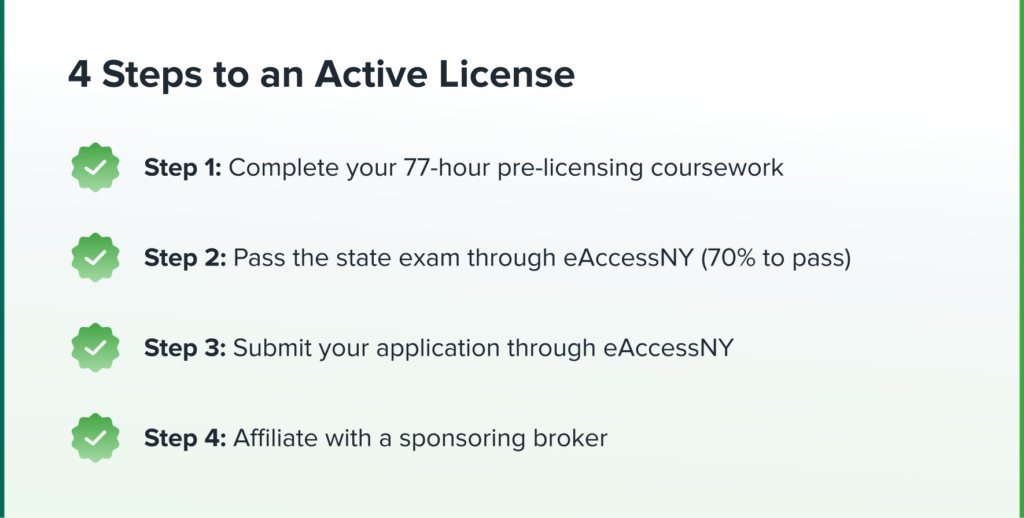
The 77-hour salesperson qualifying course comes first, offered online or in class through Department of State-approved schools. Tuition ranges from roughly $179 to $500, depending on the provider and format. The coursework ends with a proctored school exam, which the student must pass before scheduling the state exam.
Step 2: Pass the New York Real Estate Exam
The New York Department of State administers the licensing exam directly, rather than through a national vendor such as PSI or Pearson VUE. Candidates schedule the 75-question test through an eAccessNY account and take it in person at a state site.
A score of 70 percent passes, and a $15 fee applies to each attempt.
Step 3: Submit Your License Application
Candidates submit the application through the eAccessNY portal. The salesperson application fee is $65, and a sponsoring broker must authorize the application before the state processes it. The Department of State will then check the application for completeness and eligibility before issuing the license.
Step 4: Affiliate with an Employing Broker
Going independent means earning the broker license, which requires 152 hours of education plus qualifying experience. That experience takes one of the following forms:
- At least 2 years as a licensed salesperson
- 3 years in the general real estate business
- A combination that meets the state’s point requirement
Costs and Timeline
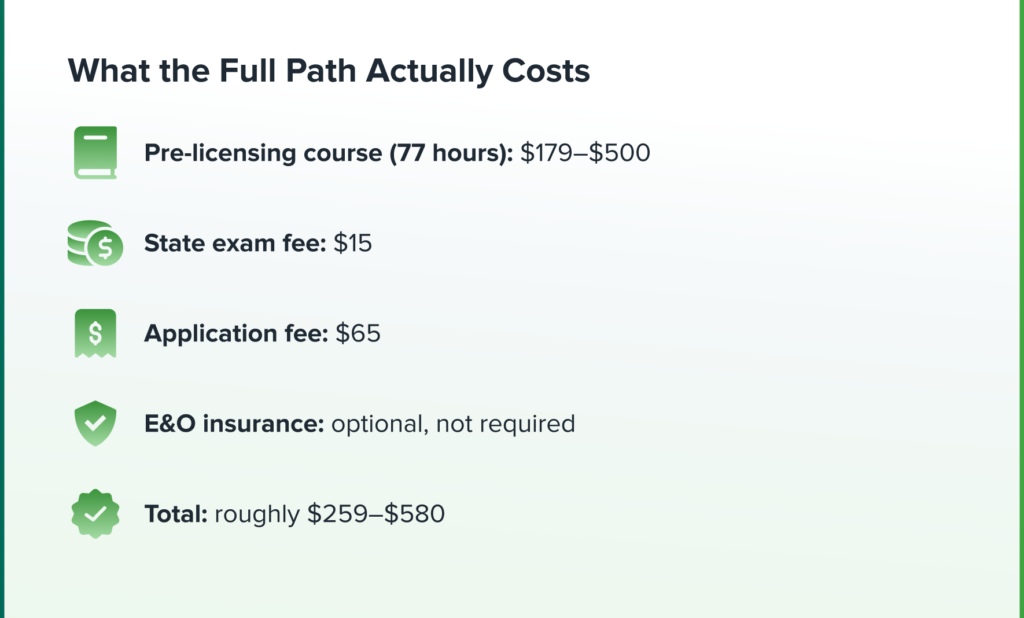
The salesperson’s path will range from $259 to $580. The spread comes from the pre-licensing course, which schools price anywhere from budget to premium depending on format and hours of live instruction. The rest are fixed state fees:
- Pre-licensing course (77 hours): $179 to $500
- State exam fee: $15
- Application fee: $65
- E&O insurance: Optional (New York does not require it)
Most candidates will move from first class to active license in about 2 to 3 months, though timelines vary. Course pace depends on the school and schedule, and the state will review the application once the sponsoring broker authorizes it.
Who is exempt from New York's license requirement?
The requirements for becoming a property manager do not apply to every person who handles a rental. Owners managing their own property don’t need a license because the activity isn’t performed for another person for compensation.
New York law also exempts several fiduciary and official roles from the licensing requirement: public officers, court-appointed receivers, referees, administrators, executors, guardians, and attorneys acting within their legal duties (N.Y. Real Prop. Law § 442-f).
What happens if you manage property without a license in New York?
New York treats unlicensed real estate activity as a crime, and the Department of State holds the authority to investigate violations and pursue enforcement. A person who acts as a broker without a license is committing a misdemeanor, which the Attorney General may prosecute (N.Y. Real Prop. Law § 442-e).
An unlicensed person also cannot sue to collect a commission or management fee for the work they conducted (N.Y. Real Prop. Law § 442-d).
Beyond the criminal charge, a court may order an unlicensed manager to pay the harmed party a penalty ranging from the compensation received up to four times that amount (N.Y. Real Prop. Law § 442-e).
Beyond the License: Starting Your New York Property Management Career
Owners expect speed and transparency once a manager takes over their property, and earning the license only clears the legal bar. With that in mind, running a property management business well takes more than credentials.
Rent collection, lease renewals, maintenance coordination, tenant screening, and owner reporting all need a system that keeps pace with a growing portfolio. TenantCloud’s property management software handles those daily duties efficiently and effectively, in one place.
As your portfolio expands, coordinators and bookkeepers may need access, which is no problem. Team management tools keep maintenance staff focused on repair tickets while owners see only what’s theirs. Plus, integrated accounting syncs with QuickBooks, keeping those statements accurate.
Start a free 14-day trial with TenantCloud and manage the day-to-day workload in one place.
Frequently Asked Questions
Do you need a real estate license to be a property manager in New York?
Yes. New York requires a real estate broker’s license or working under a sponsoring broker to manage property for others for compensation. Managing your own property doesn’t require a license. The state treats paid management as brokerage activity (N.Y. Real Prop. Law § 440-a).
How long does it take to get a property management license in New York?
Most applicants reach an active salesperson license in about 2 to 3 months, though timelines vary. Course pace depends on the school and schedule, and the Department of State reviews the application after a sponsoring broker authorizes it.
How much does a New York property management license cost?
The salesperson’s path runs roughly $259 to $580. That covers the 77-hour course at $179 to $500, the $15 exam fee, and the $65 application fee. New York does not require E&O insurance, so that stays optional.
Can I manage a rental property in New York without a license?
You can manage only the property you own yourself. Managing someone else’s rental for compensation without a license is a misdemeanor, and an unlicensed manager cannot sue to collect fees. Department of State enforcement also applies (N.Y. Real Prop. Law § 442-e, § 442-d).
What's the difference between a real estate salesperson license and a broker's license in New York?
A salesperson license permits property management activities, but only under a sponsoring broker who holds legal responsibility, not independently. A broker’s license permits independent practice. It requires 152 hours of education plus qualifying experience, whether two years as a licensed salesperson, three years in general real estate, or a combination that meets the state’s point requirement.
For most managers, the salesperson license is the entry point.