
TL;DR
- License required: Real estate license required to manage property for others for compensation. A sales associate license working under a broker at the minimum or a broker license for independent operation.
- Governing body: Florida Real Estate Commission (FREC), under the DBPR, administers and enforces Chapter 475 of the Florida Statutes.
- Pre-licensing education: 63 hours for a sales associate; 72 hours for a broker, through a FREC-approved school.
- Application and exam: Applicants submit a DBPR application with electronic fingerprinting, then pass the Florida real estate exam through Pearson VUE.
- Estimated cost: The sales associate path runs approximately $300 to $840.
- Exemptions: Owners managing their own property and salaried on-site apartment employees.
Collecting rent, signing a lease, or advertising a vacancy for an owner for pay is a regulated real estate activity in Florida. A licensed broker or sales associate may do it, but without an active license, that same paid work breaks the law. A property management license is what makes it all legal.
Working without the proper license is a third-degree felony, punishable by up to 5 years in prison and a $5,000 fine. An unlicensed manager also cannot enforce a compensation agreement in court. This guide covers how to become a property manager in Florida, including the licensing steps, expected costs, and ongoing requirements. Plus, see how property management software can help.
Duties of a Property Manager
Property management job requirements in Florida span a broad range of responsibilities, all of which a licensed manager takes on for the owner and handles directly:
- Marketing property to attract qualified tenants and fill vacancies quickly
- Collecting rent and managing owner disbursements on a consistent monthly schedule
- Drafting, executing, and enforcing lease agreements and lease renewals
- Coordinating and logging maintenance requests and paying vendors promptly
- Screening tenants and managing vacancies from application through move-in
- Handling tenant communication, including notices, disputes, and requests
- Trust accounting and owner financial reporting for each accounting period
- Conducting inspections at move-in, move-out, and throughout the lease term
- Ensuring fair housing compliance across every tenant interaction
To organize all your duties, a software for property managers can help centralize things into one place. No need to juggle spreadsheets, collect rent in person, or sort through piles of paper applications.
Does Florida require a property management license?
Yes. In Florida, a real estate license is required to manage rental property for others for compensation. The broker definition reaches anyone who, for another and for pay, rents or negotiates the rental of real property (Fla. Stat. § 475.01(1)(a)).
Executing lease agreements, collecting rent, and advertising vacancies on an owner’s behalf all fall within that definition. Each act carries legal and financial obligations to owners and tenants alike.
Third-party managers who handle someone else’s property must hold a valid Florida license, while owners who self-manage their own rentals are exempt. The Florida Real Estate Commission (FREC) administers and enforces real estate licensing across the state.
Florida Property Manager License Requirements
Property manager qualifications in Florida match the state’s real estate licensing rules. Applicants must meet the following requirements to qualify for the exam:
Age and Residency
Applicants must be at least 18 years old, hold a high school diploma or GED, and have a valid U.S. Social Security number. Florida has no residency requirement for real estate licensing.
Pre-Licensing Education
Property manager education requirements in Florida start with a FREC-approved pre-licensing course: 63 hours for the sales associate path (FREC Course I) or 72 hours for the broker path. Course completions stay valid for 2 years.
Background Check
Every application requires a criminal history review through electronic fingerprinting at a DBPR-approved Livescan provider. Florida requires good moral character, and applicants must disclose all criminal history. Convictions for fraud, dishonest dealing, or breach of trust carry weight but are not automatic disqualifiers.
Errors and Omissions Insurance
Florida does not require E&O insurance for a sales associate license, so coverage stays optional unless an employing broker requires it. E&O protects clients when a professional services mistake causes financial harm.
How to Get Your Florida Property Management License
Getting a property management license in Florida follows a set sequence. The steps to become a property manager in Florida are as follows:
Step 1: Complete Your Pre-Licensing Coursework
The pre-licensing course runs online or in person through FREC-approved schools statewide. Costs range from roughly $150 to $650, depending on the provider and format.
Step 2: Submit Your License Application
Florida requires the application to be on file before you can sit for the state exam. Applications go to the DBPR through the MyFloridaLicense portal, and the sales associate application fee is $62.75. Fingerprints must be on file before the application can be processed.
Once approved, the applicant will receive authorization to schedule the state exam. By law, the DBPR must approve or deny a complete application within 90 days, and most clear well before that (Fla. Stat. § 120.60(1)).
Step 3: Pass the Florida Real Estate Exam
With the application approved, schedule the Florida real estate examination through Pearson VUE. The sales associate exam is 100 multiple-choice questions, and a score of 75% (75 of 100) is required to pass. The exam fee is $36.75 per attempt, with retakes available at the same price.
Step 4: Affiliate with an Employing Broker
A new sales associate license is issued as “inactive” after the exam is passed. Before any compensated work can begin, the associate must affiliate with a licensed broker who takes responsibility for their professional activities. That arrangement gives new associates a legal, supervised path into the business.
The employing broker can activate the license by linking it to the brokerage through DBPR, using Form RE 11 or the broker’s online account. Those who want to operate independently will need a full broker license, which requires 24 months of active sales associate experience within the prior 5 years.
Costs and Timeline
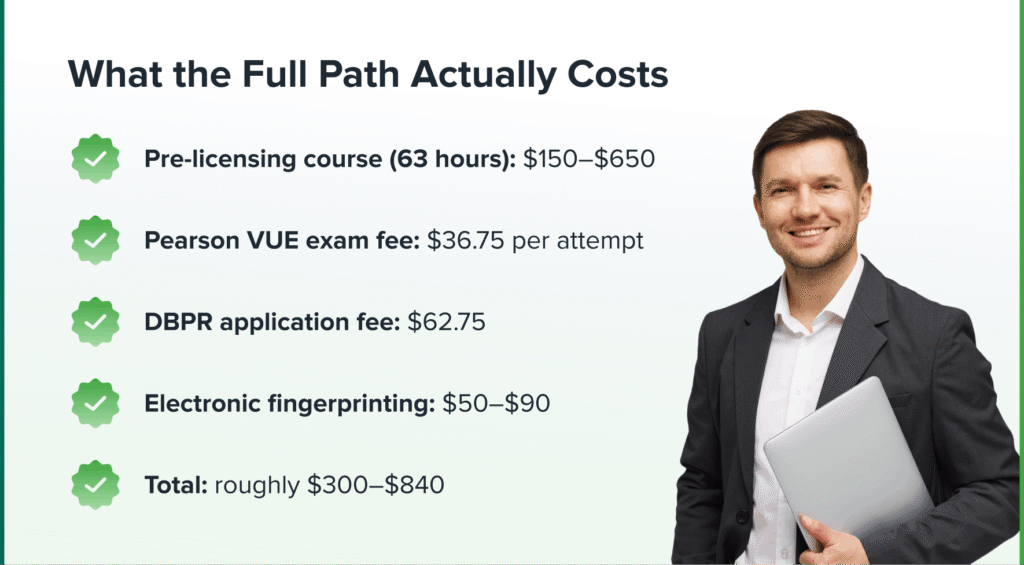
The cost to obtain a Florida sales associate license typically runs between $300 and $840, covering coursework, testing, and licensing fees, listed below:
- Pre-licensing course (63 hours): $150 to $650
- Pearson VUE exam fee: $36.75 per attempt
- DBPR application fee: $62.75
- Electronic fingerprinting: $50 to $90
Most candidates complete all steps and obtain an active sales associate license within 3 to 6 months. The broker path takes longer, as it requires 24 months of active sales associate experience before eligibility.
Who is exempt from Florida's license requirement?
Three exemptions apply to those reviewing the requirements to become a property manager in Florida:
Owners managing their own property: Any individual or entity that leases its own real property is exempt from Chapter 475, provided commission-based agents are not hired to manage it in the ordinary course of business (Fla. Stat. § 475.011(2)).
Salaried on-site apartment employees: A salaried employee of an apartment community owner who works in the on-site rental office in a leasing capacity is exempt. The employee must be salaried, not commission-based, and must work on-site at that specific community (Fla. Stat. § 475.011(4)).
Condominium and cooperative managers: A person employed as a manager of a condominium or cooperative apartment complex is exempt from rental-related activities, provided that any arranged rentals are for periods of no more than 1 year (Fla. Stat. § 475.011(5)).
What happens if you manage property without a license in Florida?
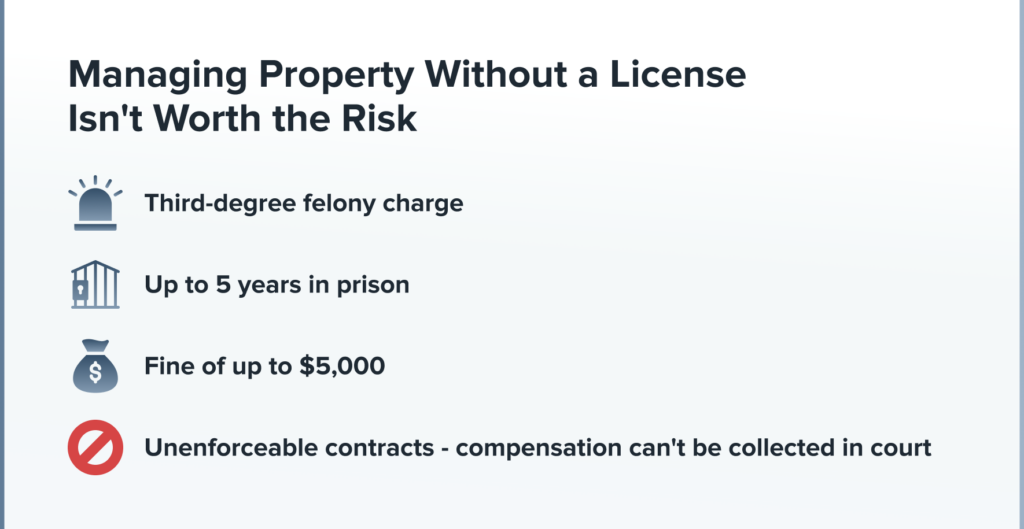
Operating as a broker or sales associate without a valid, active license is a third-degree felony in Florida, punishable by up to 5 years of imprisonment and a fine of up to $5,000 (Fla. Stat. § 475.42(1)(a), § 775.082, § 775.083).
The DBPR may seek injunctive relief to stop unlicensed activity and refer matters to law enforcement.
A contract for compensation for services that require a license is unenforceable in Florida courts, so an unlicensed operator cannot sue to collect the compensation promised under the agreement (Fla. Stat. § 475.41).
Beyond the License: Starting Your Florida Property Management Career
A Florida property manager’s real work begins after the license arrives, and well-organized workflows keep it running. Clean books and steady disbursements turn an unproven operation into one the owners will trust as it scales.
Rent collection, maintenance coordination, tenant screening, and owner reporting stack up fast once a license goes active. TenantCloud’s property management software consolidates those tasks into a single dashboard, eliminating disconnected spreadsheets and one-off phone calls.
As the portfolio grows and staff come on board, team management tools ensure each person has access only to what their role needs. And because the business runs on cash flow, integrated accounting that syncs with QuickBooks keeps owner statements accurate and disbursements on schedule.
Start a free 14-day trial with TenantCloud to run rent, maintenance, and owner reporting from one place.
Frequently Asked Questions
Do you need a real estate license to be a property manager in Florida?
In Florida, a real estate license is required to manage property for others for compensation. A sales associate license (working under a broker) is the minimum requirement, and a broker license permits independent operation. Managing your own property is exempt (Fla. Stat. § 475.011(2)).
How long does it take to get a property management license in Florida?
Most candidates obtain an active sales associate license within 3 to 6 months, including DBPR processing time and exam scheduling. The broker path takes longer, as 24 months of active sales associate experience is a prerequisite.
How much does a Florida property management license cost?
The full sales associate licensing path typically costs between $300 and $840:
- Pre-licensing course ($150 to $650)
- Pearson VUE exam fee ($36.75 per attempt)
- DBPR application fee ($62.75)
- Electronic fingerprinting ($50 to $90)
Verify current fees with FREC and DBPR before starting the licensing process.
Can I manage a rental property in Florida without a license?
Managing a property you personally own is legal without a license. Managing for another owner for compensation without a valid Florida license exposes the operator to criminal prosecution as a third-degree felony, with fines up to $5,000 (Fla. Stat. § 475.42(1)(a), § 775.083).
A contract for compensation for licensed services is also unenforceable in that situation (Fla. Stat. § 475.41).
What's the difference between a real estate salesperson license and a broker's license in Florida?
A sales associate license permits property management activities, including collecting rent, executing leases, and advertising vacancies, but requires working under a licensed employing broker. A broker’s license permits independent operation and requires at least 24 months of active licensed sales associate experience within the preceding 5 years.