
Generating a passive income from your properties is easy. You purchase a property, lease it, and the tenant pays rent on time every month.
But this process is easier said than done.
Tenants sometimes delay rent payments, causing inconvenience. As the landlord, you can usually charge a late fee to recoup your losses.
But you can’t charge an arbitrary penalty for late payments. Instead, there are certain conditions and limits that you have to follow based on your state and city.
Let’s look into them in detail.
TL;DR
- Landlords can charge a late fee for rent to compensate for inconvenience and encourage timely rent payments, but they must comply with state and local laws.
- All 50 states permit late fees, but rules differ. States may impose a fixed maximum late fee (flat fee), a percentage of the monthly rent, or set no limit (though fees must still be reasonable).
- A grace period is the time after the rent is due before a landlord can legally charge a late fee. Grace periods vary by state and must be specified in the lease agreement.
- In states without maximum limits, landlords can use a percentage (typically 5-10% of monthly rent), a flat fee ($50-$100), or a daily accrual method, while ensuring the amount is reasonable and written in the lease.
- Late fees apply after the grace period expires. If a tenant doesn't pay, further notices or eventually an eviction process may be necessary, depending on landlord-tenant laws.
- TenantCloud can automatically generate late fees and send reminders to the tenant. The tenant can pay the fee directly through the platform as well.
What is a Late Fee?
When a tenant fails to pay their rent on time (based on the lease agreement), the landlord can impose a penalty on the tenant in the form of a late fee. The tenant must pay this late fee, along with the monthly rent, to the landlord.
The late fee serves two purposes:
- Compensating the landlord for the inconvenience and potential financial loss
- Encouraging timely rent payments
The exact late fee depends on a variety of factors, like your rental agreement and the state and local laws.
You can only demand a late fee if the rent remains unpaid after the provided grace period ends.
The Rules: State and Local Late Fee Laws
All 50 states allow landlords to charge late rent, but specific limits and rules vary by state and city.
There are limits on the maximum late fees landlords can charge, guidelines on the grace periods, and the circumstances under which late fees apply.
Every state handles fees differently. Some use percentages, others use flat rates, and many leave the limit up to you. Here’s the breakdown.
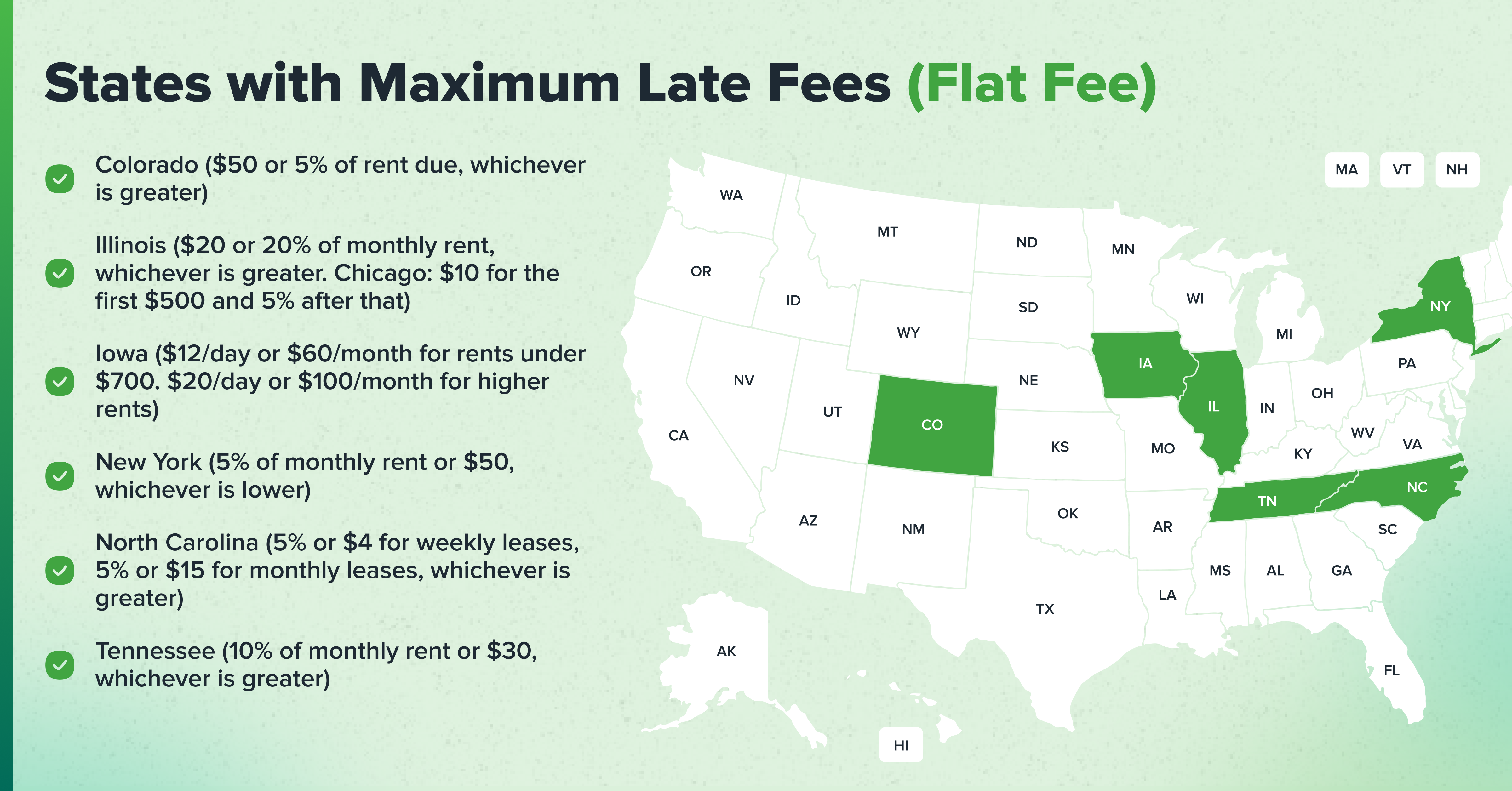
States with Maximum Late Fees (Flat Fee)
- Colorado ($50 or 5% of rent due, whichever is greater)
- Illinois ($20 or 20% of monthly rent, whichever is greater. Chicago: $10 for the first $500 and 5% after that)
- Iowa ($12/day or $60/month for rents under $700. $20/day or $100/month for higher rents)
- New York (5% of monthly rent or $50, whichever is lower)
- North Carolina (5% or $4 for weekly leases, 5% or $15 for monthly leases, whichever is greater)
- Tennessee (10% of monthly rent or $30, whichever is greater)
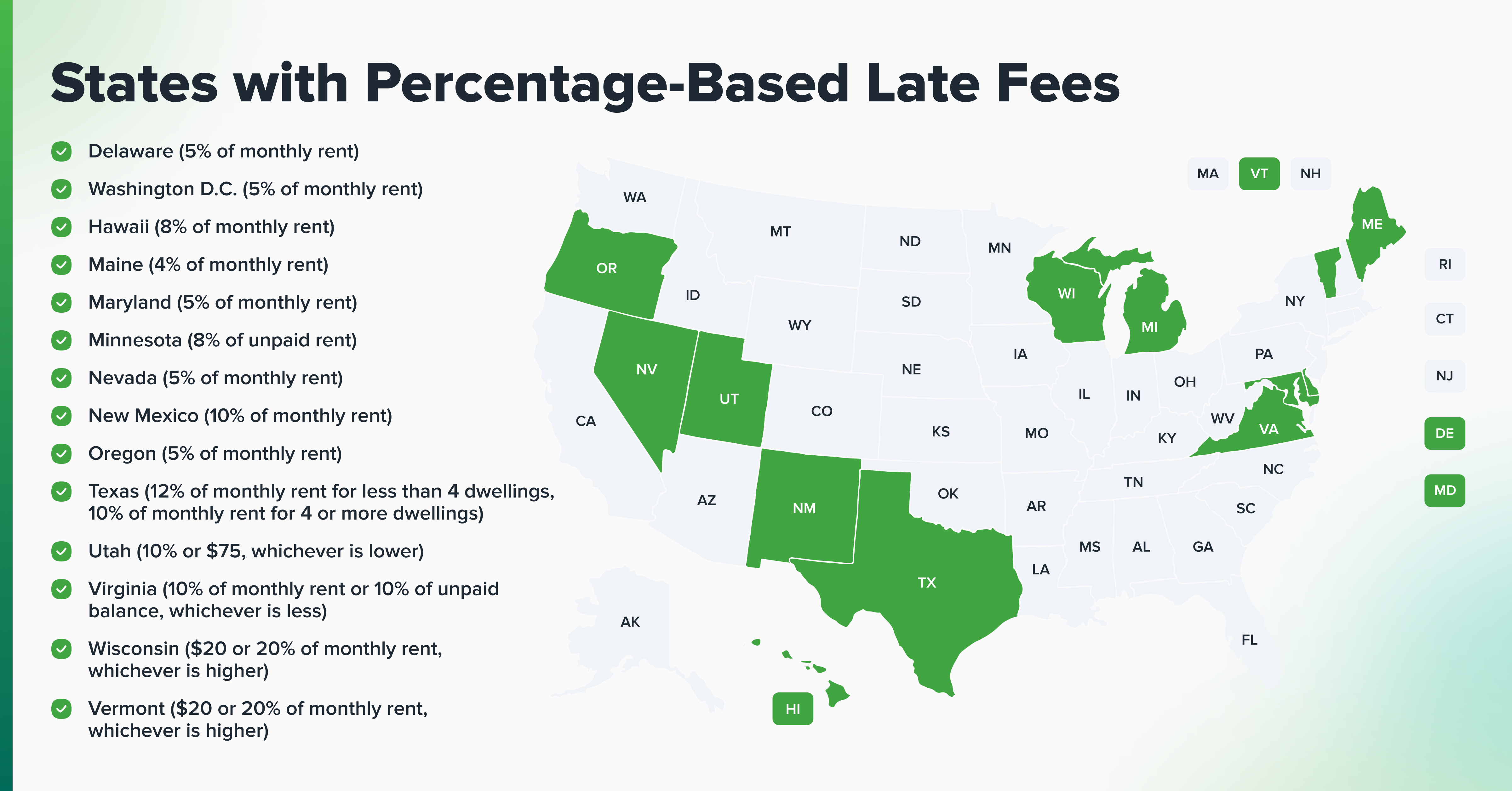
States with Percentage-Based Late Fees
- Delaware (5% of monthly rent)
- Washington D.C. (5% of monthly rent)
- Hawaii (8% of monthly rent)
- Maine (4% of monthly rent)
- Maryland (5% of monthly rent)
- Minnesota (8% of unpaid rent)
- Nevada (5% of monthly rent)
- New Mexico (10% of monthly rent)
- Oregon (5% of monthly rent)
- Texas (12% of monthly rent for less than 4 dwellings, 10% of monthly rent for 4 or more dwellings)
- Utah (10% or $75, whichever is lower)
- Virginia (10% of monthly rent or 10% of unpaid balance, whichever is less)
- Wisconsin ($20 or 20% of monthly rent, whichever is higher)
- Vermont ($20 or 20% of monthly rent, whichever is higher)
States with No Limits on the Late Fees
- Alabama
- Alaska
- Arizona (except for mobile homes, which have a limit of $5/day)
- Arkansas
- California
- Connecticut
- Florida
- Georgia
- Idaho
- Indiana
- Kansas
- Kentucky
- Louisiana
- Massachusetts
- Michigan
- Mississippi
- Missouri
- Montana
- Nebraska
- New Hampshire
- New Jersey
- North Dakota
- Ohio
- Oklahoma
- Pennsylvania
- Rhode Island
- South Carolina
- South Dakota
- Washington
- West Virginia
- Wyoming
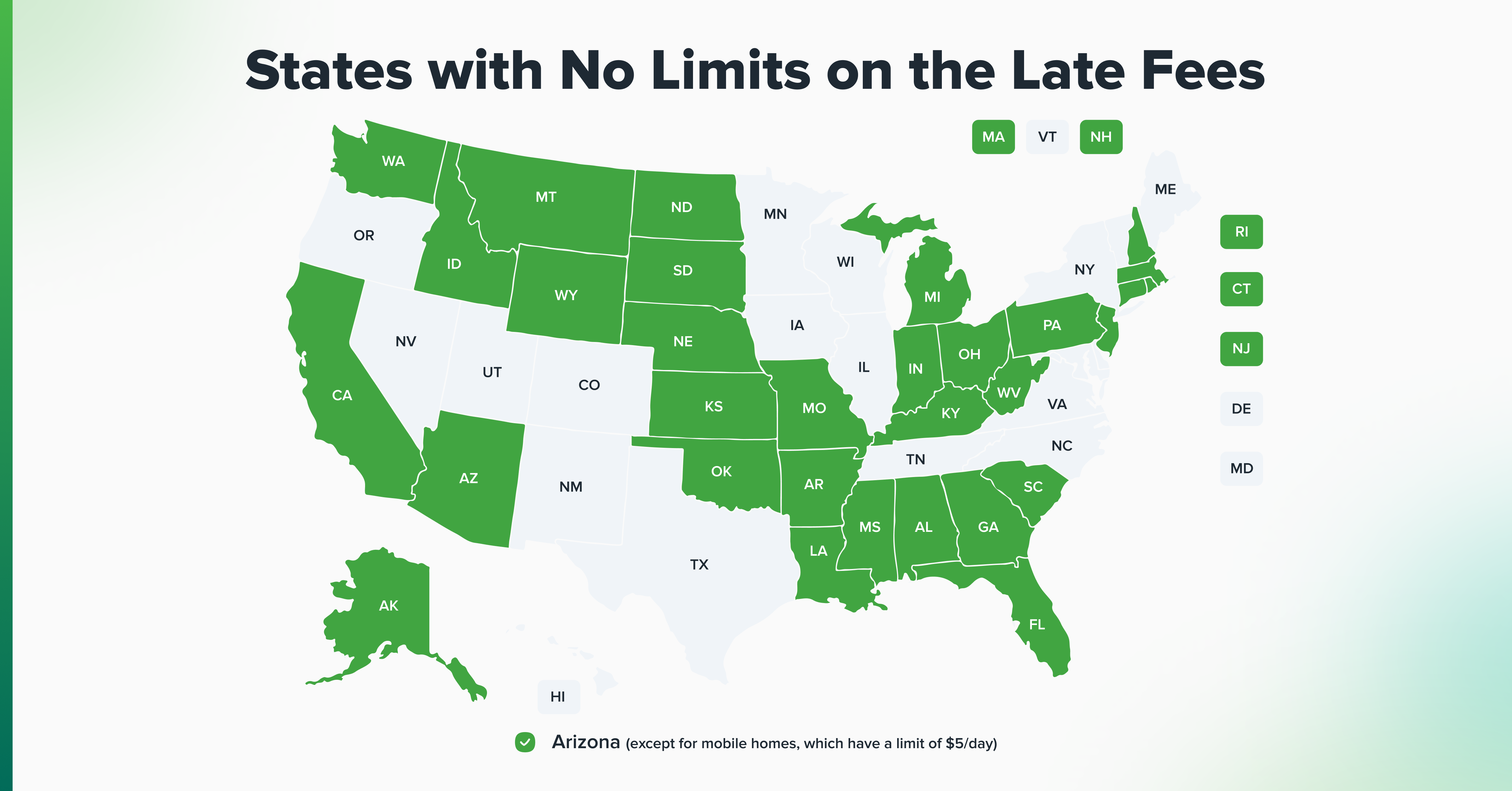
Even though the listed states don't specify limits on late fees, they must still be reasonable. You must also mention the amount or percentage values in your lease agreement for them to be valid.
When Should You Charge a Late Fee: Defining the Grace Period in Your Lease Agreement
Grace period is the time after which you can legally ask the tenant to pay the late fee. Each state has a different grace period, and some, like Arkansas and California, don’t impose any specific deadlines.
Here’s a list of states that have defined the grace period for late fees:
No matter where your property is, you should decide on a grace period before drafting and signing the lease agreement. A five-day grace period is usually fair.

An important point to note here is that a grace period isn’t a necessity. If your state doesn’t have a set minimum limit, you can remove it altogether. In that case, the tenant will have to pay the late fee even if they delay the rent payment by a day.
Setting a Reasonable Late Fee Amount
If your state sets a maximum late fee, your job is easy. All you have to do is stay at or below that limit.
Things, however, become a little more complex in other states where there’s no such limit. It’s your responsibility to set a late fee amount in these locations, while ensuring the amount is reasonable.
You can choose one of these methods for setting a late fee for your property:
Percentage
You can charge the late fee as a percentage of your monthly rent or the outstanding rental amount. Typically, a reasonable percentage fee would be about 5-10% of the monthly rent. For example, a late fee of $40 applies on a rent of $800 at 5%.
Flat Fee
Instead of a variable percentage-based amount, a flat fee is easier to communicate and more predictable. Typically, you can charge anywhere between $50 to $100 in late fees for your property. The fee can be higher for costlier properties.
Daily Accrual
This method involves charging a set amount for every day the rent is delayed after the grace period. It encourages tenants to pay up as quickly as possible to reduce the chances of the total climbing further.
You can reasonably charge between $5 to $10/day.
That said, make sure you cap the total at about 10% of the monthly rent. The courts may see anything higher as a penalty rather than a fair fee.
No matter how you decide to figure out late fees, you've got to put the specifics in your lease agreement. Be sure to include the exact amount, how long the grace period is, and the highest late fee you'll charge.
TenantCloud has options for all three systems, enabling you to manage rental payments and collect late fees with ease. The system generates late fees automatically after the set grace period ends and emails the tenant about it too.
When Are Late Rent Fees Considered Overdue?
Your monthly rent is considered overdue as soon as the grace period mentioned in your lease agreement expires. That’s when the late fee kicks in.
As a landlord, you must send a written notice to your tenant via certified mail, mentioning that the grace period has ended and they must pay the late fees.
But what happens if the tenant still doesn’t pay the rent (or late fees)? When are the late fees considered overdue?
Well, there’s no specific timeline for the late fees becoming overdue, but depending on your state, you may have to send more notices after 14 days to demand rent.
If the tenant takes no action, you could send them an eviction notice.
To reduce the chances of a tenant default, it helps to conduct tenant screening before signing the lease agreement.
Start Collecting Your Late Fees
Late fees are actually pretty helpful: they cover the money lost when rent is late and encourage tenants to pay on time.
Make sure your lease agreement clearly spells out the exact late fee, how long the grace period is, and the absolute maximum penalty.
But if you’ve got multiple properties, especially across different states, managing and tracking late fees manually becomes a task. You’d have to juggle multiple dates, late fee structures, and do a lot of number crunching.
With TenantCloud, rent collection and late fees become a breeze.
When you use the platform to manage your properties, it lets you set up late fees and send email notices automatically once the grace period expires. The tenant can also pay late fees and rent directly through the platform.
Try TenantCloud free for 14 days now to see how it can help streamline property and late fee management.
FAQ
Can I deduct unpaid late fees from the security deposit?
In most states, you can deduct late fees from the security deposit if they are outlined in the lease agreement. However, you must include them within the itemized deductions list that’s sent to the tenant at the end of the lease.
What is the best way to collect rent and late fees?
The most efficient way to collect rent is through a property management platform like TenantCloud. It ensures that if rent isn’t received by the due date, the system can automatically calculate the late fee and notify the tenant, reducing manual effort.
When exactly is a payment considered late?
A payment is considered late the moment the due date and any applicable grace period have passed. Even if a tenant initiates a transfer on the deadline, if the funds don’t reach the landlord’s account by the specified time, the payment can be called late.


