
The property management software market is rich with options.
In 2026, you've likely heard of a few of them, including AppFolio and Yardi. Both are popular platforms that offer large-scale property management operations. The question most landlords are actually asking, though, isn't which of the two is more powerful – it's which one is right for their portfolio, their workflow, and their budget.
This guide breaks down AppFolio vs Yardi across pricing, features, and practical fit. It also breaks down a third popular option: TenantCloud.
TL;DR
While AppFolio offers strong automation and a modern interface, it’s best suited for mid- to large residential portfolios of 200+ units. In contrast, Yardi offers a broader product line with deep commercial and specialty property capabilities. However, both platforms carry high costs and high complexity that put them out of reach for most independent landlords.
TenantCloud covers the same core operational needs at a fraction of the price, with no unit minimums, transparent pricing, and a straightforward onboarding experience built for DIY and small-to-mid-portfolio landlords.
AppFolio vs Yardi: A High-Level Overview
AppFolio launched in 2006 and has spent the years since building a platform aimed squarely at residential property management companies. The platform now serves over eight million units across the United States, with a product line that spans residential, commercial, student housing, and community associations. The latest features include AI automation through its Realm-X platform, which handles everything from leasing inquiries to maintenance workflows via agentic operations.
Yardi's history is longer and its scope is wider. Founded in 1984, Yardi has built a comprehensive real estate software ecosystem featuring two core products for property managers:
- Yardi Breeze is a cloud-based platform built for small-to-mid-sized operators.
- Yardi Voyager Suite is an enterprise system designed for institutional-scale portfolios with complex commercial, specialty, and mixed-use requirements.
In the Yardi vs AppFolio comparison, the most important thing to understand upfront is scale:
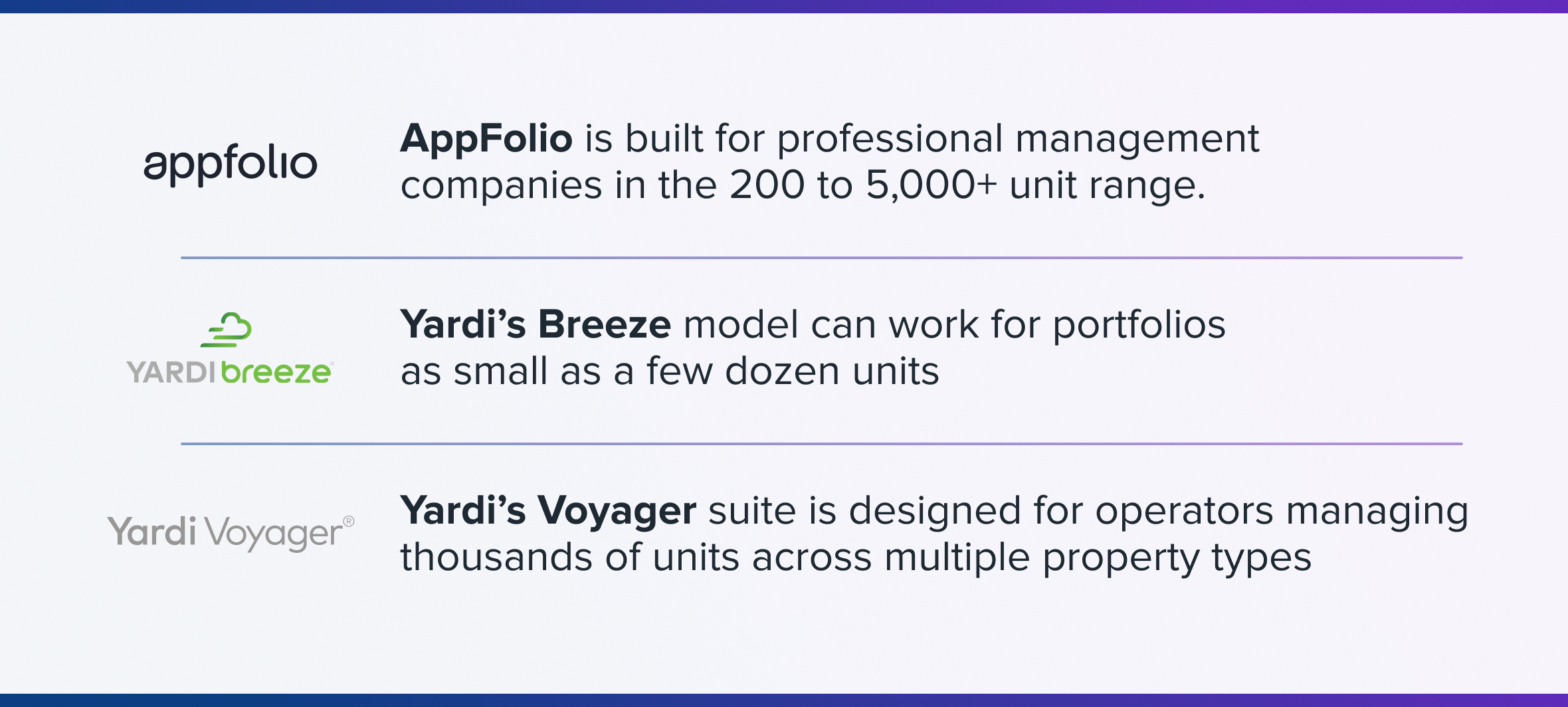
- AppFolio is built for professional management companies in the 200 to 5,000+ unit range.
- Yardi’s Breeze model can work for portfolios as small as a few dozen units
- Yardi’s Voyager suite is designed for operators managing thousands of units across multiple property types
Pricing Breakdown: Is AppFolio or Yardi Better for Your Budget?
Pricing is where the AppFolio vs Yardi comparison is most revealing. Here’s an exploration of what fees you can expect from these two choices.
AppFolio 2026 Pricing
- AppFolio's Core tier starts at $1.40 per unit per month, but the 50-unit minimum means a landlord with 50 units pays $280/month regardless, making the effective per-unit cost $5.60.
- Their Plus tier runs $3 per unit per month with a $900 monthly minimum, and the Max tier is $5 per unit per month with a $1,500 monthly minimum.
- Payment processing fees, add-on services, and transaction charges can add 15% to 40% to your base subscription costs annually, and onboarding fees are non-refundable.
The honest baseline price for AppFolio is around $280/month, starting.
Yardi 2026 Pricing
Yardi's approach differs by product tier.
- Yardi Breeze starts at $1 per unit per month for residential properties, with a $100/month minimum, and free implementation and training are included.
- Yardi Breeze Premier starts at $2 per unit per month.
- Yardi Voyager, on the other hand, does not publish their pricing. Reported starting points for Voyager range from $1,200 per month for smaller configurations to $75,000 per year for mid-market operators.
- Implementation for Voyager is a separate cost that can equal or exceed the first year of licensing.
For DIY landlords and small operators, both platforms present a different reality: the per-unit entry price looks accessible until the minimums, onboarding fees, and add-on costs are fully revealed. These platforms are best suited for large and enterprise portfolios with expansive needs and budgets.
Core Feature Comparison: Accounting, Maintenance, and Automation
Let's determine whether each capability is a good fit for your actual operational needs.
Accounting
AppFolio's reporting suite is strong, with real-time dashboards and performance benchmarking. Its accounting tools are built for professional management companies, and include capabilities like:
- Automated bank reconciliation
- Smart bill entry
- Owner distribution management
- A full general ledger
Yardi Voyager goes deeper on accounting complexity, particularly for commercial and mixed-use portfolios with:
- Sophisticated lease structures
- CAM reconciliation
- Institutional reporting requirements
Meanwhile, Yardi Breeze handles the accounting basics, including:
- A/P
- A/R
- General ledger
- Financial reporting
This is more than adequate for smaller operations.
Maintenance and automation
AppFolio's Realm-X platform, rolled out across 2025, integrates AI-powered maintenance triage and automated tenant communication into a single workflow. Maintenance requests are tracked, assigned, and followed through the platform with vendor integrations and status visibility for all parties. Agentic leasing assistants handle tenant inquiries around the clock, and workflow automation can significantly reduce delinquencies.
Yardi Breeze handles maintenance requests competently through a tenant portal, but without the AI-driven automation depth that AppFolio has built into its core platform.
Yardi Voyager offers some modular maintenance tools, though these are add-ons with separate pricing.
User interface
AppFolio is broadly considered more modern and intuitive than Yardi Voyager, which carries the complexity of a system that has evolved over decades.
Yardi Breeze, by contrast, is well-regarded for its clean interface and ease of onboarding.
An Affordable Alternative: TenantCloud vs AppFolio and Yardi
Here's the question that the Yardi vs AppFolio debate doesn't ask often enough: what if you're managing 50 units or fewer, and don't need extensive infrastructure at enterprise prices?
The vast majority of U.S. landlords (approximately 14.1 million) are individual investors who own between 1 and 4 units. For this population, AppFolio and Yardi may be simply too large.
Let’s break down how each of these companies’ offerings compares with an alternative like TenantCloud.
TenantCloud vs AppFolio
TenantCloud starts at $15/month with:
- No unit minimums
- No onboarding fee
- A 14-day free trial
Compared to AppFolio’s minimum price of $280/month, that pricing gap is not subtle. It’s the difference between a tool that fits your business and one that requires your business to fit the tool.
Feature-for-feature for the essentials like:
- Online rent collection
- Rental applications
- Tenant screening
- Lease management with e-signatures
- Maintenance tracking, and
- Financial reporting
TenantCloud covers the same operational ground AppFolio does at the entry level, without the overhead.
TenantCloud vs Yardi
The comparison shifts slightly depending on which Yardi product you compare against.
- Against Yardi Breeze, TenantCloud is competitive on both price and features, but TenantCloud's $15/month starting point and no minimum structure still represent a more accessible entry point, particularly for landlords managing a handful of units.
- Against Yardi Voyager, TenantCloud isn't really a direct competitor. What TenantCloud offers instead is the full operational toolkit for the landlord that Voyager was never designed to help: the independent owner, the small portfolio investor, or the self-managing professional who wants their rental business to run cleanly without enterprise software overhead.
TenantCloud's plans (Starter, Growth, Pro, and Business) scale from individual DIY landlords through professional property management companies with transparent pricing, no implementation fees, and a platform that can be up and running in a day rather than six months.
Core capabilities include:
- Online rent collection with autopay
- TransUnion-powered tenant screening
- Digital lease creation with e-signatures
- Maintenance request management through a tenant portal
- Financial reporting
- Listing syndication across major rental platforms
All of those features sit in one place, with a low barrier to entry and no hidden fees.
Making Your Choice in 2026
The AppFolio vs Yardi debate is a good place to start – as long as you’re operating at the scale both platforms were designed for.
For mid-to-large property management companies managing 200 or more residential units and wanting best-in-class automation, AppFolio is the stronger choice in 2026.
For operators managing complex commercial portfolios, mixed-use properties, or institutional-scale residential assets, Yardi Voyager remains the gold standard – with the implementation cost and operational complexity that comes with it.
For everyone else – independent landlords, small portfolio investors, DIY property managers, and self-managing professionals – you may have better luck with an alternative due to pricing and scale alone.
Manage with TenantCloud
TenantCloud is built for the landlord who needs professional tools, not enterprise infrastructure. Our promise to landlords includes transparent pricing, no unit minimums, a 14-day free trial, and a platform that handles the full rental lifecycle without requiring months of onboarding or dedicated staff to run it.
Ready to find out how it can impact your portfolio? Start your free TenantCloud trial today and see why over 100,000 landlords use it to manage their rental business.
Frequently Asked Questions
What is the main difference between AppFolio and Yardi?
AppFolio is a cloud-native platform built primarily for mid-to-large residential property management companies, with strong automation and a modern user interface. Yardi offers two distinct products: Yardi Breeze for small-to-mid portfolios, and Yardi Voyager for enterprise and institutional operations. AppFolio focuses on residential at scale, while Yardi spans more property types and organizational sizes through its modular architecture.
Is AppFolio or Yardi better for small landlords?
Neither is a natural fit for small landlords. AppFolio's Core plan carries a $280/month minimum, and while Yardi Breeze is more accessible at $100/month minimum, it still represents significant overhead for a landlord managing a handful of units. Platforms like TenantCloud are specifically designed for the 1 to 50 unit range, starting at $15/month with no unit minimums.
How do AppFolio and Yardi compare on pricing?
AppFolio's advertised rate of $1.40/unit may look accessible, but it has a 50-unit minimum, so the per-month floor is actually $280/month. Yardi Breeze starts at $1/unit per month with a $100/month minimum, while Yardi Voyager is custom-priced and typically costs $30,000–$75,000/year for mid-market operators.
What features do AppFolio and Yardi share?
Both platforms cover the core property management workflow: online rent collection, tenant screening, lease management, maintenance tracking, accounting, and financial reporting.
Is TenantCloud a legitimate alternative to AppFolio and Yardi?
For landlords managing under 50 units, yes – and it’s often a better fit than either. TenantCloud covers the same essential operational ground (rent collection, screening, lease management, maintenance, and financial reporting) without the unit minimums, implementation fees, or enterprise complexity. TenantCloud is recognized for its competitive pricing and strong value for the features offered, making it an attractive choice for landlords and property managers seeking cost-effective solutions.
Which is easier to use: AppFolio or Yardi?
AppFolio is generally considered more intuitive and modern than Yardi Voyager, which carries significant complexity from decades of development. Yardi Breeze was redesigned specifically to be more accessible, and users rate it highly for ease of navigation. Both platforms, however, involve a meaningful learning curve compared to purpose-built tools for smaller operators.


