
As landlords and property managers build and expand their portfolios, the question of which property management software is best becomes increasingly important. There are several considerations to keep in mind when choosing between platforms, such as portfolio size, must-have features, and cost.
In this guide, we’ll walk you through the pros and cons of two of the biggest software options: AppFolio and Buildium. We’ll also offer some scenarios where TenantCloud could be a good fit.
TL;DR
When comparing Buildium vs AppFolio, the most important consideration is portfolio size. Buildium is best for landlords and property managers with 100-500 units, while AppFolio is a good choice for large property management companies with over 500 properties.
AppFolio offers a powerful suite of tools powered by AI, but the premium features come with enterprise software prices ranging from $298 up to $1,500+ per month. Buildium starts at $62/month, but has hidden fees for transactions and e-signing.
For DIY landlords interested in an entry-level software that can scale as they build their portfolio, TenantCloud is a good alternative. Paid plans start at $15/month, and higher tier plans are available with more robust features as you grow your business.
The Search for Efficient Property Management
Like the housing market itself, the business model of property management evolves at an accelerating pace. With each day, it seems, new and more complex challenges arise, such as:
- Tenant expectations
- High turnover
- Rising operating costs
- Automated accounting needs
- Staffing difficulties
- Regulatory compliance in a rapidly evolving legislative landscape
To help combat the challenges of managing a portfolio of properties, many property managers turn to these known competitors in the software landscape: AppFolio and Buildium. On the surface, the two property management software seem more or less interchangeable. However, they offer completely unique advantages.
The biggest difference between AppFolio and Buildium is the real estate portfolio sizes they serve. One is good for larger portfolios of 200 or more properties, while the other is better suited to mid-sized to large portfolios.
There are also functional differences to consider, like AI integration and subscription fees. Before making a final choice, it’s useful to have a preliminary list of features and benefits you need out of a property management software.
Furthermore, what if you’re a small landlord with a handful of properties looking for a simple, DIY solution? We have an option for that as well.
High-Level Overview: Buildium vs AppFolio
First, let’s do a broad comparison of the biggest differences between Buildium and AppFolio. We’ll also look at what the two have in common.
AppFolio Overview
AppFolio is a titan in the property management software offerings available. It was one of the first platforms to adopt AI-powered features, and has a smooth, all-in-one mobile interface.
With a built-in AI leasing assistant, AppFolio is ideal for automating tenant management for hundreds of properties. Things like maintenance requests, leasing paperwork, and even tenant communication can all be mostly hands-off.
The full suite of workflow features makes AppFolio a good choice for scalability. While many software becomes untenable after you reach a certain number of properties, AppFolio shines with larger portfolios. However, the premium features come at a higher cost, and learning the software can be difficult.
Pros:
- Robust integration of AI automation
- Advanced maintenance processing
- Comprehensive platform with all the bells and whistles
Cons:
- Higher cost (starts at $298/month)
- 50-unit minimum portfolio size
- Steep learning curve
Buildium Overview
While AppFolio is purpose-built for large portfolios and commercial properties, Buildium is a more user-friendly choice for mid-sized property management businesses with 50-200 properties. The accounting features of Buildium are one of the biggest selling points, simplifying tax filing, report generation, and recordkeeping.
Another positive of Buildium is its ease of use. The platform has a user-friendly interface that’s easy to learn even for users who aren’t tech savvy. Many users also report that Buildium also has a more responsive support team if you run into issues with the software. Best of all, Buildium has a lower financial barrier to entry than AppFolio, with plans starting at &62/month
Between its record-keeping features and ease of use, Buildium is a good middle-ground option for landlords who want professional-grade software but don’t manage a large enough portfolio to warrant the cost of AppFolio. At the same time, the software doesn’t scale as well as portfolios reach a certain size.
Pros:
- Lower cost than AppFolio
- Detailed recordkeeping
- Easy to learn
Cons:
- Limited features by comparison
- Less customizable
- Doesn’t scale well with large portfolios
Core Similarities
While they have their distinctions, AppFolio and Buildium also have a lot in common, such as:
- Maintenance tracking
- Tenant screening
- Rent collection
- Compliant accounting
- Tenant communication
- Leasing tools
- Cloud-based software
- AI automation
Deep Dive: AppFolio vs Buildium Feature Comparison
Now that you have a general sense of the big differences between AppFolio and Buildium, it’s a good idea to do a detailed, side-by-side comparison of each feature offered by both platforms. Here’s how each software performs on key features:
Accounting & Reporting
AppFolio offers advanced reporting options, including fully customizable reports. AppFolio leverages AI to streamline billing and accounting. Using the Smart Accounting feature, property managers can scan invoices and bills into the app and automate traditionally manual processes such as budgeting, bill entry, and bank feed transactions. The software then aggregates that data into optimized, customizable reports. You can filter data points such as bank account activity, cash flow, and delinquency records.
With Buildium, property managers also have access to an impressive array of reporting tools for the monthly price. However, the reports aren’t as comprehensive and customizable as those of AppFolio. Buildium’s suite of accounting features includes automated bank reconciliation, accounts payable, and transaction record tracking.
Overall, AppFolio offers a more comprehensive set of accounting and reporting features. On the other hand, Buildium’s accounting tools have a lower learning curve, and the price difference likely outweighs the feature set for most landlords.
Tenant Screening & Leasing
For tenant screening and leasing processes, AppFolio and Buildium take different approaches, but both perform well. Buildium’s integrated screening software is powered by TransUnion, the credit reporting agency. The software imports a background report from TransUnion that includes income, eviction records, criminal background, and credit ratings.
As with other features, AppFolio relies on its AI integration for leasing processes. The onboard AI agent automatically responds to rental applicants to schedule tours and calls. From there, AppFolio generates a to-do list for each lead, automating leasing tasks.
AppFolio has its own proprietary screening system called FolioScreen Trusted Renter. Rather than importing data from a reporting agency, the software has built-in income verification and background screening. This also means the screening process is usually faster with AppFolio than with Buildium.
Maintenance Management
Handling maintenance requests is an important part of daily operations for property managers. Completing work orders quickly helps reduce tenant turnover and prevents repair costs from piling up. Buildium and AppFolio both offer robust maintenance management features.
Buildium’s platform allows tenants to submit requests within the mobile app and upload notes and photos. Property managers can also pay vendors directly from the software. Buildium can also identify recurring maintenance tasks and send automated requests to vendors on a schedule. The software generates a detailed report of every maintenance invoice.
AppFolio offers even more automation to reduce the workload associated with maintenance management. The onboard AI processes maintenance requests immediately and reaches out to vendors for you. Repair technicians can then upload photos and track time on the mobile app for an all-in-one solution.
User Interface
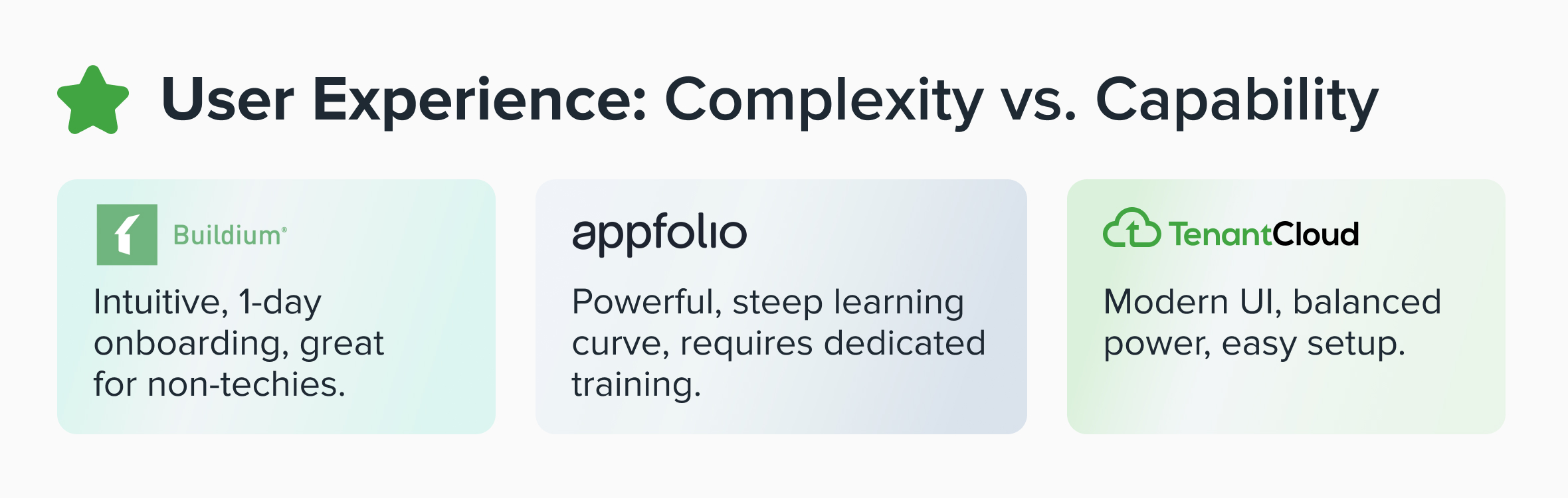
Many users find that Buildium is easier to implement, while AppFolio offers a more powerful dashboard of tools. While Buildium is user-friendly and intuitive, AppFolio has more options to customize the dashboard and built-in AI to automate tasks.
Pricing Breakdown: Which Offers Better ROI?
Both AppFolio and Buildium offer multiple pricing tiers. Buildium has a lower entry cost than AppFolio, but are AppFolio’s extra features worth the cost? Let’s break down the pricing tiers for each software and compare them side by side.
AppFolio Pricing Model
AppFolio charges a per-unit fee, with monthly minimums. The platform has a 50-unit minimum, but the minimum spend requirement means it’s usually only a viable solution for portfolios of 200 or more properties.
The pricing plans are:
- Core: ~$1.50/unit with $298/month minimum (200 units)
- Plus: ~$3.20/unit with $960/month minimum (300 units)
- Max: ~$5.00/unit with $7,500/month minimum (1,500 units)
With each plan tier, AppFolio offers expanded features as well:
- Core: Base plan with accounting, reporting, maintenance management, Realm-X AI assistant, and standard support
- Plus: Affordable and student housing, budgeting features, AppFolio API, automated billing and maintenance scheduling
- Max: Leasing CRM and dedicated support team
AppFolio is known for its premium features and high-volume capability, but the high onboarding costs and minimum monthly fees can make it a non-starter for those with mid-size or smaller portfolios.
Buildium Pricing Model
Buildium is a more budget-friendly option for landlords with portfolios ranging from a few properties to hundreds or more. The platform doesn’t have a minimum unit or monthly spend requirement, and per-unit costs decrease as you add units to your portfolio. Paying annually also reduces the per-unit price.
Pricing tiers for Buildium are:
- Essential: Starts at $62/month, with a maximum of 150 units
- Growth: Starts at $192/month
- Premium: Starts at $400/month
The features offered with each pricing tier include:
- Essential: Accounting, maintenance management, tenant communication, online portal
- Growth: Advanced analytics, free property inspections, and unlimited digital signatures
- Premium: Buildium API, dedicated consultant, Marketplace Premium integration
While Buildium has a much lower entry cost than AppFolio, it also comes with hidden fees for things like e-signatures and bank transactions, especially with the lower pricing tiers. These fees can add up for smaller landlords.
Both AppFolio and Buildium can be cost-effective for large property management portfolios. Which one offers a better ROI depends on your specific needs and portfolio size. Buildium is usually most cost-effective in the 50-200-unit range, while portfolios of over 200 generally make the higher cost of AppFolio worth it for the premium features.
However, neither of these software addresses the needs of landlords with smaller portfolios. For portfolios of fewer than 50 units, even Buildium’s lower price can be a turnoff for DIY landlords.
The Missing Piece: Why Small & Mid-Sized Landlords Need an Alternative
Both Buildium and AppFolio justify their monthly prices with expansive suites of features. However, DIY landlords and growing property managers may end up paying for features they don’t use. Plus, with unit minimums, it can be difficult to expand a portfolio enough to warrant the cost of enterprise software.
Small and mid-size landlords may be tempted to use free or low-cost property management software. While that may work as a temporary solution, many free software options can be difficult to use and have clunky interfaces. Even worse, as you invest in more units, many cheaper software options can quickly become insufficient for your growing list of daily operations.
The ideal solution for starting out with a smaller portfolio is software that offers a low entry cost for basics like rent collection, maintenance requests, and application processing. As you scale your portfolio, your property management software should scale with you to meet your needs.
Enter the Ultimate Alternative: AppFolio vs Buildium vs TenantCloud
TenantCloud is a scalable property management software suitable for portfolios of any size. Whether you’re a DIY landlord with one or two properties, or a property manager for hundreds of units, there’s a pricing tier to suit any budget.
TenantCloud offers several advantages over Buildium and AppFolio when it comes to price:
- Flat-rate pricing: Your monthly costs for property management software stay consistent and predictable, with no extra fees per unit.
- Zero unit minimums: Every pricing tier is available for portfolios of any size.
- Free basic plans: In addition to paid plans, TenantCloud has a free tier if you just need basic features to simplify online processes.
TenantCloud vs AppFolio vs Buildium Features
Even though TenantCloud is a budget-friendly alternative to enterprise software, that doesn’t mean it’s short of advanced features.
Here’s a brief TenantCloud vs AppFolio vs Buildium feature comparison:
- Accounting: TenantCloud’s built-in accounting software can generate tax reports, record and track expenses, and handle bank reconciliation. AppFolio offers more AI-powered automation, and Buildium creates detailed, comprehensive reports.
- Maintenance requests: TenantCloud offers invoice linking and messaging in the app, so property managers can track repairs and coordinate with vendors. Buildium has image uploading and AppFolio’s AI automation is a powerful tool, but TenantCloud is the best “bang for your buck” for handling maintenance tasks.
- Tenant screening: Like Buildium, TenantCloud pulls from TransUnion consumer reports to predict risks. For criminal checks, TenantCloud uses Asurint. Plus, tenants pay for the screening report, which reduces the operational cost to the property manager.
- Inspections: TenantCloud’s mobile app allows DIY landlords to conduct property inspections in just minutes while making notes and uploading photos and videos. Comparing Buildium vs AppFolio for small landlords, Buildium offers customizable checklists while AppFolio’s AI inspection tool can help identify potential issues and automate maintenance.
- Team management: The difference between team management features for Buildium vs AppFolio vs TenantCloud also comes down to cost/benefit. All three software options have in-app communication, but only TenantCloud scales with your team from the ground up.
Final Verdict: Which Software Should You Choose?
The best property management software for landlords in the USA depends on the size of your portfolio and the specific features you need most, as well as your budget. These are the ideal use cases for each platform:
- AppFolio: Best for larger property management companies with 500 or more units or portfolios that include a mix of residential and commercial properties
- Buildium: A good middle-ground for landlords with 100+ units or who need robust HOA features and comprehensive recordkeeping
- TenantCloud: Ideal for DIY landlords and property managers looking for maximum efficiency, affordable flat-rate pricing, and a user-friendly interface
Ultimately, the question of which property management is best for you doesn’t have a one-size-fits-all answer. Consider how many properties you already manage and how much you plan to scale your rental business.
Buildium and AppFolio have powerful onboard tools and features, but they’re rarely the best starting point for DIY landlords. Minimum unit requirements and monthly costs create a big barrier to entry.
For landlords with 1-50 rental units, TenantCloud is a good all-around option for getting started with property management software. Paid plans start at just $15/month, and higher plan tiers are available as you scale up your business. Get started with a free 14-day trial today.
FAQs
Is Buildium better than AppFolio?
Buildium offers a better value than AppFolio for mid-size property management businesses. It’s also a more user-friendly software that’s easy to implement for smaller teams. However, AppFolio’s AI integration allows landlords to automate complex tasks like responding to inquiries and scheduling maintenance, making it a good choice for larger portfolios of 500 or more units.
Who does Buildium, AppFolio, and TenantCloud use for tenant screening?
Buildium pulls credit, background, and rental history from TransUnion reports. AppFolio has a proprietary screening software built into their platform called FolioScreen Trusted Renter. TenantCloud uses TransUnion for credit checks and Asurint for criminal history checks.
What is the best property management software for small landlords?
TenantCloud is a budget-friendly alternative to more expensive enterprise software like AppFolio and Buildium. With multiple paid plan tiers starting at $15/month, TenantCloud is a good all-around choice for DIY landlords or larger property management companies.
What is the best AI for property management?
AppFolio currently has the most robust AI integration in their property management software. The platform uses Realm-X to generate reports and act as an automated virtual assistant. The onboard leasing assistant can also respond to applicants and schedule maintenance and repairs automatically.
TenantCloud also leverages AI tools for smart tenant screening, compliance, and drafting rental listing descriptions.
What is the best free property management software?
TenantCloud offers a free basic plan for DIY landlords who only manage a handful of properties. The free tier offers an online portal for rent collection and basic accounting features. Paid plans start at $15/month. When it comes to TenantCloud vs Landlord Studio, both platforms offer a free tier, but TenantCloud has a much more comprehensive suite of features.


